This is a guest post from my daughter. It is the outcome of an effort today to kill multiple birds with one stone. First, I have a daughter at home on summer holiday who needs to do more than watch TV or play video games all day and as much as I’d like to go for a long walk or bike ride, I do have work. Second, after overhearing online meeting discussions about plans for new campus spaces the other day she offered some really interesting insights I wanted to capture. Third, in my efforts to find genuine productivity affordances for generative AI I wanted to test the MS Teams transcription function and combine that with ChatGPT text analysis and re-write. So, below is the result. We chatted via Teams for about 15 minutes. I uploaded the transcript to ChatGPT with this prompt: Isolate all comments from ‘Inaya Compton’ then using her arguments and ideas compose a 500 word blog post written in the first person. We then edited the output together and deleted ChatGPT’s typical formulaic conclusion. We decorated the post with a couple of Midjourney images using her prompt: top down view of a classroom with tables in groups of four with two chairs on each side and a board at 90 degrees to the chairs along one wall. Finally, we used the inbuilt AI assistant to review grammar and do a final edit (Paragraph 5 was reworked to be ‘serious’ in tone).

Screenshot from the editor window of this post showing toolbar with three star icon for ‘AI assistant’ highlighted
———————–
Hi, I’m Inaya Compton. As a student, I am enthusiastic and eager to learn, valuing both the intellectual richness of the classroom and the importance of conversation in broadening perspectives. Here, I would like to share some of my insights on the most conducive learning environments, based on my experiences as a learner.
Let’s begin with the significance of the learning space itself. The size of the classroom matters a lot to me. If it’s too large, it creates a sense of separation, while a small space can feel too restrictive. It’s essential to strike the right balance between creating a sense of unity and allowing for individual freedom.
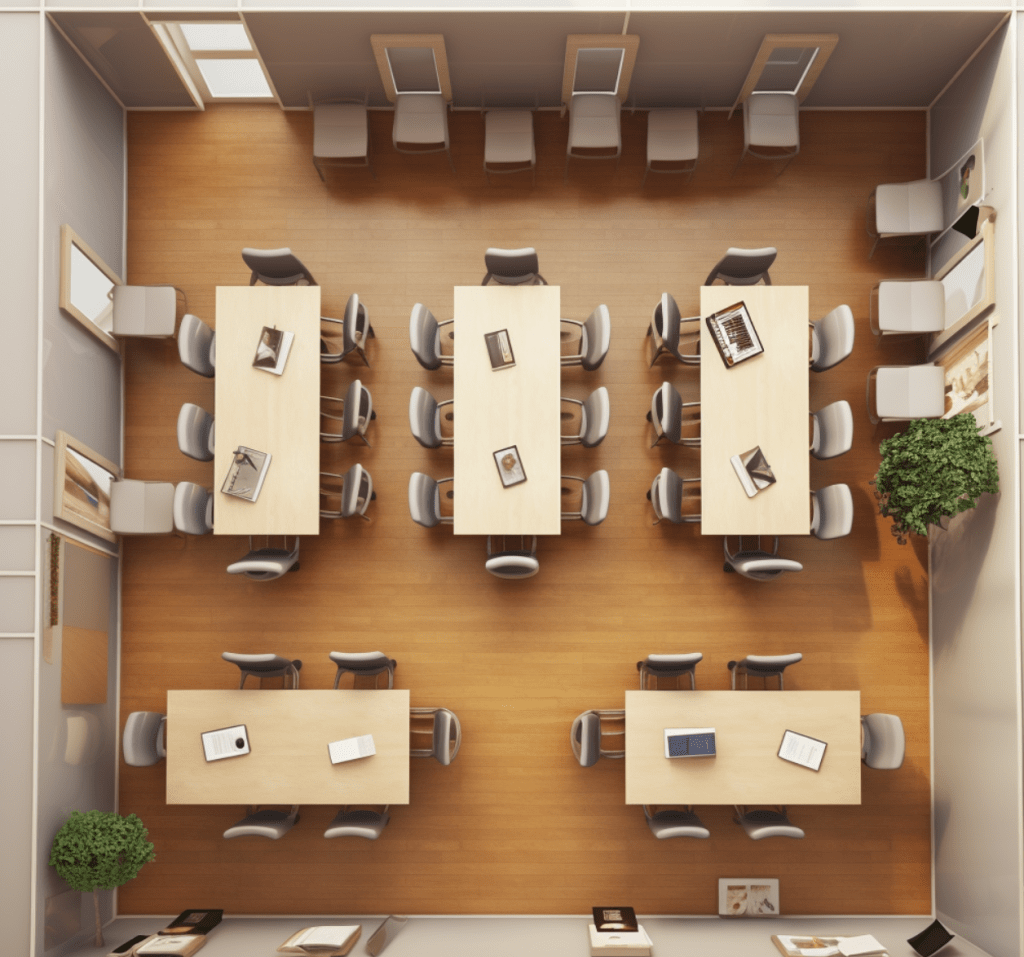
Top down view of classroom generated in Midjourney showing 5 desks each with 6 or 8 chairs around it.
When it comes to teaching small groups, say up to about 10 students, a primary challenge is student engagement and cooperation. The smaller the group, the lesser the interaction dynamics. There’s also a risk of students not learning how to engage with a wider range of people, which is a crucial life skill.
Teachers often struggle with how to address students who don’t readily answer questions. My take on this is that students should have their space. Instead of forcing participation, provide them with an option to indicate their comfort levels with a topic before the session. By giving them an overview of questions and letting them hear other students’ responses, they can still participate indirectly and learn in their way.
When it comes to managing large classes, such as university lectures, adapting the pace to accommodate the diverse learning needs of students can be quite challenging. Within a single class, there exists a wide spectrum of learning speeds, ranging from quick learners to slow learners, with many falling somewhere in between. The task at hand is to ensure that no student is left behind while also avoiding boredom among the more advanced students. Achieving this delicate balance necessitates educators who possess the versatility and adaptability required to effectively cater to the varied learning speeds within the classroom.
Now, let’s talk about the physical arrangement of the classroom. I believe the teacher should remain at the front as it gives a comprehensive range to the class. As for student seating, desks should not be arranged in rows, but instead, every student should be in groups but also able to see the teacher or, more importantly the board or the learning materials. The table configuration in my primary school worked well, with two students on each side of the table, thus avoiding the need for turning around completely.
Top-down view of a classroom, showing a random range of desks of different sizes with varying numbers of chairs and a central paper-covered desk.

It’s worth considering multiple screens in a medium-sized room. Having more than one screen would benefit those seated at difficult angles. And yes, the desks should be movable for a fresh feel every once in a while. It gives a sense of newness, fostering a comfortable learning environment.
Speaking of comfort, this includes the right lighting, temperature, and air flow. A classroom that’s too bright or too dark can be distracting, as can one that’s too cold or too hot. Here in England, for instance, heaters should be used only in winter – don’t keep them on as soon as February hits! Air flow is crucial too, to prevent the room from becoming stuffy.
Finally, seating arrangements should be thought through. My suggestion is to allow students some agency in deciding their seating, depending on their specific needs, such as those with glasses or those who prefer more or less involvement in class. Students with learning difficulties or disabilities should be seated closer to the board and have access to an assistant teacher for personalized help, thereby ensuring that everyone gets the attention they need.
——————-
The various stages we went through to produce this make me think that this will likely become increasingly routine and , although I was keen to really push the generative AI contribuiton, I can already see how the boundaries in some writing between human and AI authorship will be increasingly blurred, hard to track and profoundly complex in providence.
 HEducationist