Bots with character

This is a swift intro to character AI *(note 1)- a tool that is available to use for free currently (on a freemium model). My daughter showed it to me some months ago. It appears as a novelty app but is used (as I understand it) beyond entertainment for creative activity, gaming, role playing and even emotional support. For me it is the potential to test ideas that many have about bot potential for learning that is most interesting. By shifting focus away from ‘generating essays’ it is possible to see the appeal of natural language exchanges to augment learning in a novel medium. While I can think of dozens of use cases based on the way I currently (for example) use YouTube to help me to learn how to unblock a washing machine I imagine that is a continuum that goes all the way up to teacher replacement.*(note 2) Character AI is built on large language model, employs ‘reinforcement’ (learning as coversations continue) and provides an easy to learn interface (basically typing stuff in boxes) that allows you to ground the bot with ease in a wysiwyg interface.

As I see it, it offers three significant modifications in the default interface to standard (free) LLMs. 1. You can create characters and define their knowledge and ‘personality’ traits by having space to ground the bot behaviour through customisation. 2. You can have voice exchanges by ‘calling’ the character. 3. Most importantly, it shifts the technology back to interaction and away from lengthy generation (though they can still go on a bit if you don’t bake succinctness in!) What interests me most is the potential to use tools like this to augment learning, add some novelty and provide reinforcement opportunity through text or voice based exchanges. I have experimented with creating some academic architypes for my students to converse with. This one is a compassionate pedagogue, this one is keen on AI for teaching and learning, this one a real AI sceptic, this one deeply worried about academic integrity. They each have a back story, defined university role and expertise. I tried to get people to test arguments and counter arguments and to work through difficult academic encounters. It’s had mixed reviews so far: Some love it; some REALLY do not like it at all!

How do/ could you use a tool like this?

Note 1. This video in no way connotes promotion or recommendation (by me or by my employer) of this software. Never upload data you are not comfortable sharing and never upload your own or other’s personal data.

Note 2: I am not a proponent of this! There may be people who think this is the panacea to chronic educational underfunding though so beware.
Meet my slightly posher, potentially evil twin

I have been awestruck by the capabilities of tools like HeyGen and Synthesia in the way they can create videos voiced by AI avatars and, with HeyGen in particular, translate from one language to another. The latest beta tool in HeyGen enables someone with limited technical skills (i.e. me) to create an AI avatar of themselves. This is a screen recording on me conversing with my twin. I could choose to speak with it/ him in a number of languages and on topics outside the grounding though it is bland and vague in those spaces. Apparently with some nudging away from the highbrow his Hindi is pretty good and his French sounds Quebecois. I grounded it in the King’s central guidance on GenAI and a few other things I have written. For now only sharing the the recording while I get to grips with the implications of this. I have honed the base prompt so that the twin is crisper in response and doesn’t waffle on. What do you think of this? What are genuine educational use cases that are not about putting humans out of work?

Conversing with AI: Natural language exchanges with and among the bots

In the fast evolving landscape of AI tools, two recent releases have really caught my attention: Google’s NotebookLM and the advanced conversational features in ChatGPT. Both offer intriguing possibilities for how we might interact with AI in more natural, fluid ways.

NotebookLM, still in its experimental stage and free to use, is well worth exploring- as one of my King’s colleagues pointed out recently: it’s about time Google did something impressive in this space! Its standout feature is the ability to generate surprisingly natural-sounding ‘auto podcasts’. I’ve been particularly struck by how the AI voice avatars exchange and overlap in their speech patterns, mimicking the cadence of real conversation. This authenticity is both impressive and slightly unsettling and at least two colleagues thought they were listing to human exchanges.

I tested this feature with three distinct topics:

Language learning in the age of AI (based on three online articles):

A rather flattering exchange about my blog posts (created in fact by my former colleague Gerhard Kristandl – I’m not that egotistical):

A summary of King’s generative AI guidance:

The results were remarkably coherent and engaging. Beyond this, NotebookLM offers other useful features such as the ability to upload multiple file formats, synthesise high-level summaries, and generate questions to help interrogate the material. Perhaps most usefully, it visually represents the sources of information cited in response to your queries, making the retrieval-augmented generation process transparent.

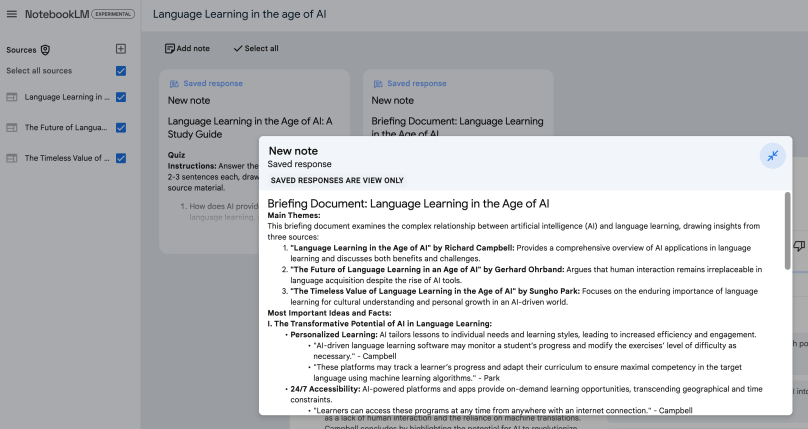
The image is a screenshot of a NotebookLM (experimental) interface with a note titled "Briefing Document: Language Learning in the Age of AI." It includes main themes and insights from three sources on the relationship between artificial intelligence (AI) and language learning:

1. **"Language Learning in the Age of AI" by Richard Campbell**: Discusses AI applications in language learning, highlighting both benefits and challenges.
2. **"The Future of Language Learning in an Age of AI" by Gerhard Ohrband**: Emphasizes that human interaction remains crucial despite AI tools in language acquisition.
3. **"The Timeless Value of Language Learning in the Age of AI" by Sungho Park**: Focuses on the cultural and personal value of language learning in an AI-driven world.

The note then expands on important ideas, specifically on the transformative potential of AI in language learning, such as personalized learning and 24/7 accessibility through AI-driven platforms.

Meanwhile, ChatGPT’s latest update advance voice feature (not available in EU, by the way) has addressed previous latency issues, resulting in a much more realistic exchange. To test this, I engaged in a brief conversation, asking it to switch accents mid-dialogue. The fluidity of the interaction was notable, feeling much closer to a natural conversation than previous iterations. Watch here:

What struck me during this exchange was how easily I slipped into treating the AI as a sentient being. At one point, I found myself saying “thank you”, while at another I felt a bit bad when I abruptly interrupted. This tendency to anthropomorphise these tools is deeply ingrained and hard to avoid, especially as the interactions become more natural. It raises interesting questions about how we relate to AI and whether this human-like interaction is beneficial or potentially problematic.

These developments challenge our conventions around writing and authorship. As these tools become more sophisticated, the line between human and AI-generated content blurs further. What constitutes a ‘valid’ tool for authorship in this new landscape? How do we navigate the ethical implications of using AI in this way?

What are your thoughts on these developments? How might you see yourself using tools like NotebookLM or the advanced ChatGPT in your work?

Sources used for the Langauge ‘podcast’:

  1. Language Learning in the Age of AI” by Richard Campbell
  2. The Future of Language Learning in an Age of AI” by Gerhard Ohrband
  3. The Timeless Value of Language Learning in the Age of AI” by Sungho Park

The Essay in the Age of AI: a test case for transformation

We need to get beyond entrenched thinking. We need to see that we are at a threshold of change in many of the ways that we work, write, study, research etc. Large language models as a key development in AI (with ChatGPT as a symbolic shorthand for that) have led to some pretty extreme pronouncements. Many see it as an existential threat, heralding the ‘death of the essay’ for example. These narratives, though, are unhelpful as they oversimplify a complex issue and mask long-standing, evidence-informed calls for change in educational assessment practices (and wider pedagogic practices). The ‘death of the essay’ narratives do though give us an opportunity to interrogate the thinking and (mis)understandings that underpin these discourses and tensions. We have a chance to challenge tacit assumptions about the value and purpose of essays as one aspect of educational practice that has been considered an immutable part of the ways learning and the evaluation of that learning happens. We are at a point where it is not just people like me (teacher trainers; instructional designers; academic developers; enthusiastic tech fiddlers; contrarians; compassionate & critical pedagogues; disability advocates etc.) that are voicing concerns about conventional practices. My view is that we leverage the heck out of this opportunity and find ways to effect change that is meaningful, scalable, responsive and coherent.

So it was that in a conversation over coffee (in my favourite coffee shop in the Strand area)  on these things with Claire Gordon (Director of the Eden Centre at LSE) that we decided to use the essay as a stimulus for a synthesis of thinking and to evolve a Manifesto for the essay (and other long form writing) in the age of AI.  To explore these ideas further, we invited colleagues from King’s College London and the London School of Economics (as well as special guests from Richmond American University and the University of Sydney) to a workshop. We explored questions like:

  • What are the core issues and concerns surrounding essays in the age of AI?
  • What alternatives might we consider in our quest for validity, reliability and authenticity?
  • Why do some educators and students love the essay format, and why do others not?
  • What is the future of writing? What gains can we harness, especially in terms of equity and inclusion?
  • How might we conceptualise human/hybrid writing processes?

A morning of sharing research, discussion, debate and reflection enabled us to draft and subsequently hone and fine tune a collection of provocations which we have called a ‘Manifesto for the Essay in the age of AI’

I invite you to read our full manifesto and the accompanying blog post outlining our workshop discussions. As we navigate this period of significant change in higher education, it’s crucial that we engage in open, critical dialogue about the future of assessment.

What are your thoughts on the role of essays in the age of AI? Or, indeed, how assessment and teaching will change shape over the next few years? I welcome your comments and reflections below.