Is AI like a cute puppy?

Audio version of this post

TL:DR? No, it is not, so why would you embrace it?

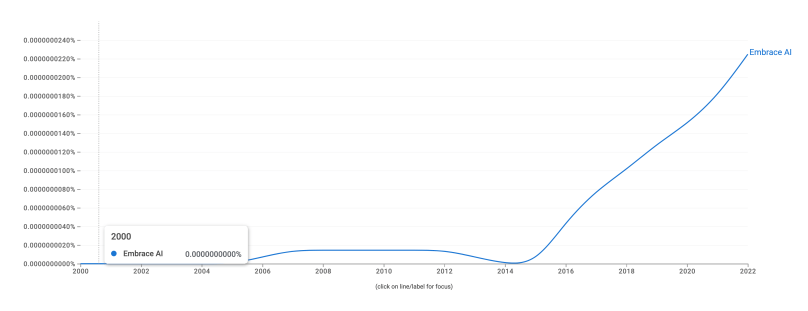
I have mentioned this before but it keeps cropping up so I am going to labour the point again. The idea of ‘embracing’ AI in education (or anywhere) can be seen to grow as a narrative throughout 2023 and was already on a steep upward trajectory prior to that.

A line chart showing the frequency of the phrase “Embrace AI” in published texts from 2000 to 2022. The horizontal axis runs from 2000 to 2022; the vertical axis shows tiny percentage values from 0 % up to 0.00000024 %. From 2000 through about 2014, the blue line hugs the baseline at essentially 0 %, with a very slight rise between 2006 and 2012 and a dip around 2014. Beginning around 2015, the line climbs steeply, reaching approximately 0.00000022 % by 2022. A tooltip at the year 2000 notes a value of 0.00000000 %.
Google Ngram viewer for ‘Embrace AI’

But a significant contribution to this notion came in this HEPI blog of 5 January 2024. Professor Yike Guo urges UK universities to move beyond mere caution and become active adopters of artificial intelligence. Drawing on 34 years of AI, data-mining and machine-learning research at Imperial College London and his  role as Provost at HKUST, he warned that AI is not a peripheral tool but a fundamental shift in the educational paradigm. His focus on structural, systemic and pre-existing issues in how we construct education such as  the persistence of rote memorisation in curricula mirrors my own case for using AI as an opportunity to leverage research-informed changes long needed. Professor Guo advocates for compulsory AI literacy modules that teach students to interrogate and collaborate with digital co-pilots and insists that the true value of education will lie in cultivating ethical reasoning, emotional intelligence and creativity which, importantly, are qualities that machines cannot replicate. He says (and I quote this a lot):

“…UK universities face a choice: either embrace AI as an integral component of academic pursuit or risk obsolescence in a world where digital co-pilots could become as ubiquitous as textbooks.”

I tend to agree with much of Professor Guo’s stance: AI will reshape (and already is)  higher education pretty profoundly but I find his call to “embrace” AI really troubling. This phrase seems to be everywhere in relation to AI. I hear it every day and I don’t  think it is helpful at all.  I embrace my wife and daughter (and, somewhat awkwardly, my son and my mum: it’s a generational thing I think!), a kitten, and even my Spurs-supporting mates last week when we finally won a trophy after 17 years of pain (see picture below). 

A photograph taken inside a dimly lit bar showing a joyous celebration among football supporters. In the foreground, an older man wearing glasses and a flat cap laughs with his mouth wide open as a younger man embraces him from behind, both arms wrapped around his shoulders. The younger man, in a light trench coat, leans in close, smiling broadly. Behind them to the right, two other fans—one in a yellow Tottenham Hotspur shirt bearing the name “Kane” and the number 7—are similarly embracing. The background is softly focused, revealing a few more patrons and industrial-style décor with exposed beams and abstract wall art.
Me being embraced by my Spurs buddy ‘JM’ (Photo: Tom Sweetland)

But I do not embrace people or things I neither know nor trust. I do not embrace strangers. Even when I employed someone to complete a loft conversion, and we came to know them well over the course of the (interminable) job, we still didn’t end up hugging each other. Some people love their phones too much and might kiss and hug them but I think they’re daft. These are tools, nothing more. ‘Embracing AI’ narratives only feed anthropomorphism. It also feeds binary narratives: are you ‘fully embrace’ or ‘outright reject’? Actually, reality demands something far more nuanced.

To these ends, I am constantly challenging the idea of embracing AI. So, instead, I argue for engagement. We can engage with affection, care, warmth and appreciation, but we can also engage with suspicion, trepidation, anxiety, distrust, even fear. Engagement accommodates critical scrutiny as readily as it does positive and productive collaboration.So, bottom line, let’s drop the idea of embracing AI but encourage critical engagement with AI (in all its diversity…what we conceptualise AI as is another thing that vexes me btw). Also: Come on you Spurs!

Blank canvases

Inspired by something I saw in a meeting yesterday morning, I returned today to Gemini Canvas and Claude equivalent (still not sure what it is called). Both these tools are designed to enable you to “go from a blank slate to dynamic previews to share-worthy creations, in minutes.”

The resource I used was The Renaissance of the Essay? (LSE Impact Blog) and the accompanying Manifesto which Claire Gordon (LSE) and I led on with input from colleagues from LSE and here at King’s. I wondered how easily I could make the manifesto a little more dynamic and interactive. In the first instance I was thinking about activating engagement beyond the scroll and secondly thinking about text inputs and reflections.

The basic version in Gemini was a 4th-iteration output where after initial very basic prompt:

“turn this into an interactive web-based and shareable resource”

…I tweaked (using natural language) the underpinning code so that the boxes were formatted better for readability and to minimise scrolling and the reflection component went from purely additional text to a clickable pop-up. I need to test with a screen reader to see how that works of course.

I then experimented with adding reflection boxes and an export notes function. It took 3 or 4 tweaks (largely due to copy text function limits in browser) but this is the latest version. Obviously with work this could be made to look nicer but I’m impressed with initial output and ability to iterate and for functionality in very short time (about 15 mins total).

For the Claude one I thought I’d try having all those features including in-text input interaction from the start. Perhaps that was a mistake, because although the intial output looked great, the text input was buggy. 13 iterations later and I got the input fix. However, then the export function that I’d added around version 3 had stopped working so I needed to do a lot more back and forth. In the end I ran out of time (about 40 mins in and at version 19) and settled on this version with the inadequate copy/ paste function.

It’s all still relatively new and what’s weird about the whole thing is the continual release of beta tools, experiemtnal spaces and things that in any other context would not be released to the World. Nevertheless, there is already utility visible here and no doubt they will continue to improve. I sometimes think that my biggest barrier to finding utility is my own limited imagination. I defintiely vibe off seeing what others have done. This further underlines for me the difference and a significant problem we have going forward. ‘Here’s a thing.’ they say. “What’s it for?’ we ask. ‘I dunno,’ they shrug, ‘efficiency?’

My prompt for this was:
‘tech bros shrugging’

The Manus from U.N.C.L.E.

‘Deploying AI agents’ sounds so hi tech and futuristic to (non Comp-Sci) me whilst weirdly also resonating of classic 60s and 70s TV shows I loved as a kid. I have been fiddling for a while on the blurred boundaries between LLMs and Agents, notably with Claude, but what appealed when I first saw Manus was the execution of outputs seemingly beyond what Claude can manage. Funnily enough it looks quite a bit like Claude but it seems it is actually a multi-tool agent. I pretty much concur with the conclusion from the MIT Tech review:

While it occasionally lacks understanding of what it’s being asked to do, makes incorrect assumptions, or cuts corners to expedite tasks, it explains its reasoning clearly, is remarkably adaptable, and can improve substantially when provided with detailed instructions or feedback. Ultimately, it’s promising but not perfect.

Caiwei Chen

Anyway, I finally got in, having been on the Manus waitlist for a while. Developed by Chinese startup Monica, it is an autonomous AI agent capable of executing complex online tasks without ongoing human input and created something of a buzz. TL:DR: This is the initial output from first prompt to web-based execution. The selection and categorisation need honing but this in my view is an impressive output. The second version after addition of a follow up prompt.

Longer version:

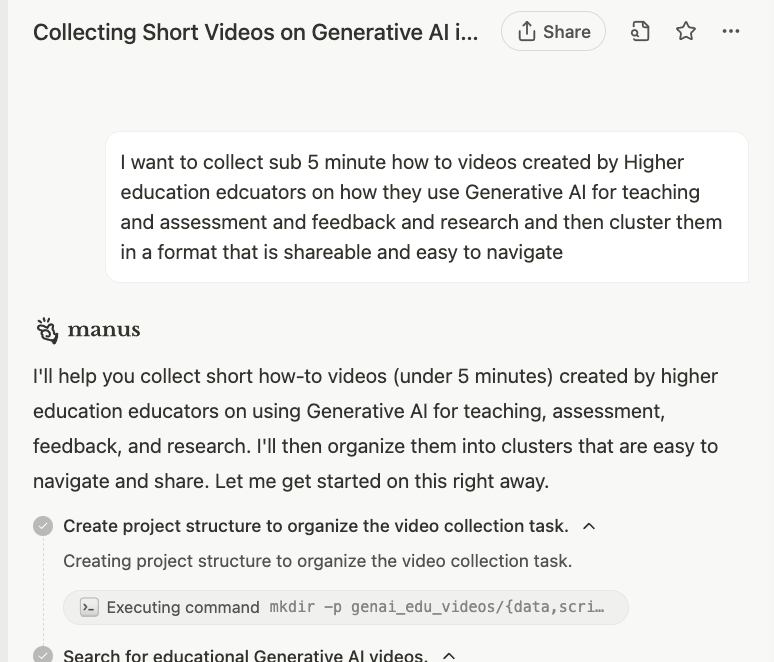
I wanted to see what I could get from a single prompt so decided to see if it could build a shareable, searchable web page that curates short how-to videos (under five minutes) by higher education educators demonstrating uses of Generative AI. I began by requesting Manus to collect and cluster videos showing how AI is applied in teaching, assessment, feedback, and research (Natural Language Prompt). Manus responded immediately by creating a structured project directory and initiating web searches to identify relevant video content, starting with collections from institutions like Notre Dame and Harvard (which it didn’t get beyond in the first iteration).

Once videos were sourced, Manus automatically filtered them to ensure they were under five minutes in length (but failed to note that one wasn’t a video and others linked to same page where they were already curated!) and produced by educators in the higher education sector (this it did get right). It then categorised them by thematic area (Teaching, Assessment & Feedback, AI Literacy, and Research but the categrosations were not always spot on) while also tagging institutional affiliations (mostly OK). The tagging and filtering work pretty well but the actual sourcing is very limited in that first iteration. A metadata database was created to support an interactive interface, allowing users to search videos by presenter, title, or description and filter by category or institution. Manus built this interface and deployed the collection to a live web page: https://cjubrvkx.manus.space. It took about 15 minutes. Iteration is by natural language prompting for fine tuning.

The initial prompt from me and the start of the executaiton of the processes

After launch, I expanded the scope by asking Manus to include contributions from additional individuals and institutions- I threw in my old buddy Dr. Gerhard Kristandl (Dr GeeKay) who I know has a YouTube channel, I added me- Martin Compton (without any additional info) and it found relevant content from each of us. The other three potential souces I threw in reaped no reward though. This is the reasoning:

I searched for content from Tadhg Blommerde, University of Sydney, and Monash University as well, but most of their videos exceeded our 5-minute duration criteria. I’ve documented all findings in the data directory for reference.

Manus resumed its asynchronous task execution, searching for and integrating further video content into the existing framework enabling me to publish a second version . So the output works, I would need much more thoughtful prompting to get it how I want it and, tbh, there are better ways of curating YouTube content but the principle is what interested me and the output is remarkable given the stages and processes it went through.

You can watch a replay of the agent in action here. Not as much fun as watching Napoleon Solo and Illya Kuryakin combat THRUSH (I know, I know).

Meme-ingful reflections on AI, teaching and assessment

I did a session earlier today for the RAISE special interest group on AI. I thought I’d have a bit of fun with it 1. because I was originally invited by Dr. Tadhg Blommerde (and Dr. Amarpreet Kaur) who likes a heterodox approach (see his YouTube channel here) and 2. Because I was preparing on Friday evening and my daughter was looking over my shoulder and suggesting more and more memes. Anyway, I was just reading the chat back and note my former colleague Steve asked: “Is the rest of the sector really short of memes these days now that Martin has them all?” I felt guilty so decided to share them back.

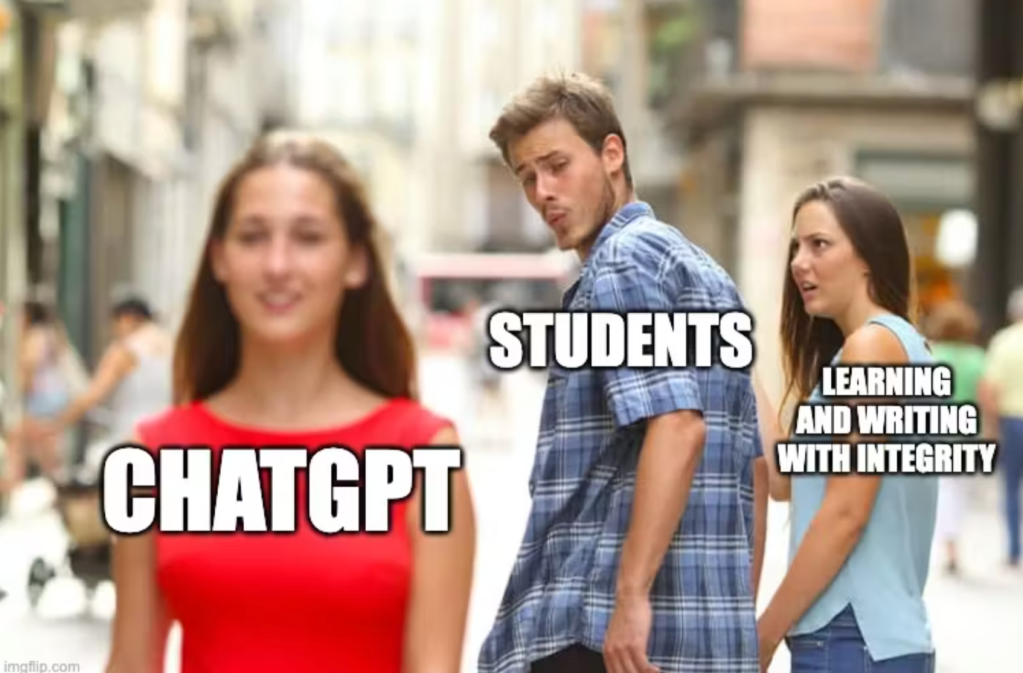
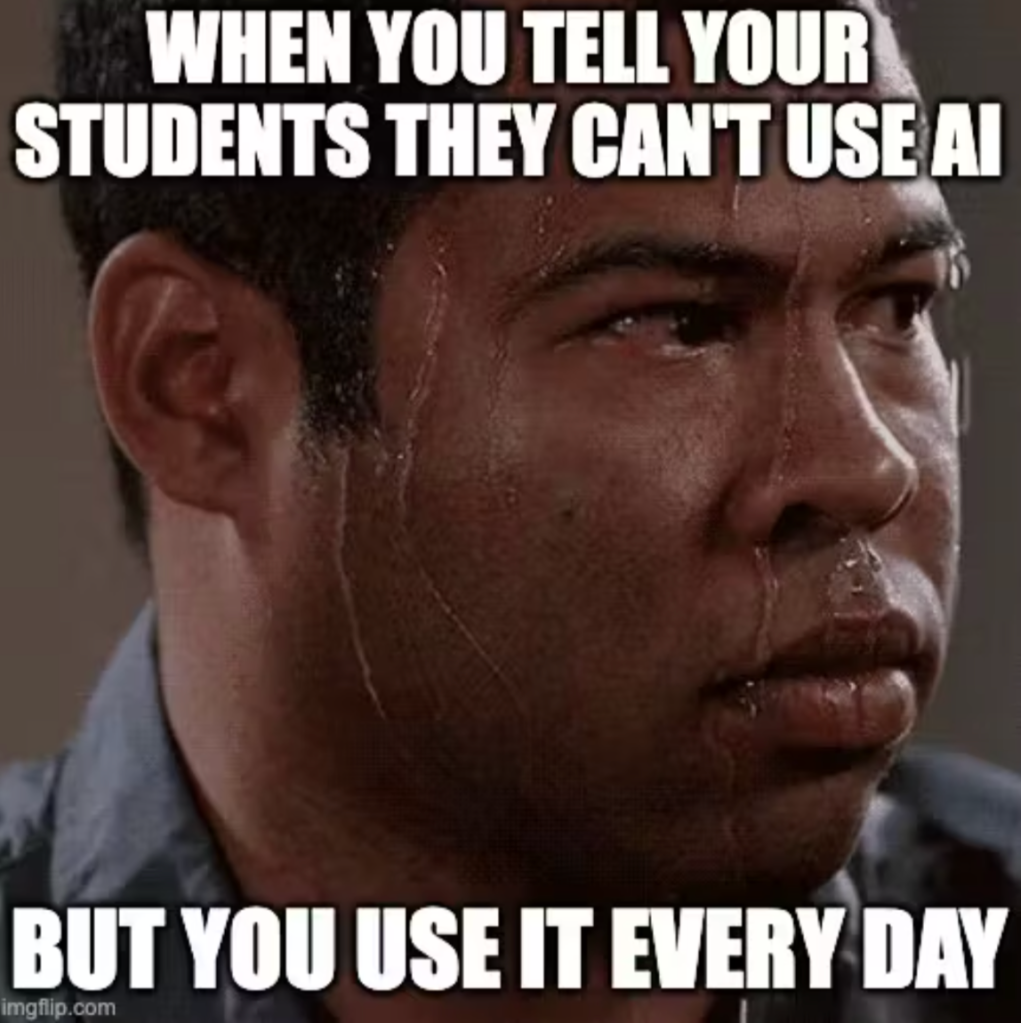
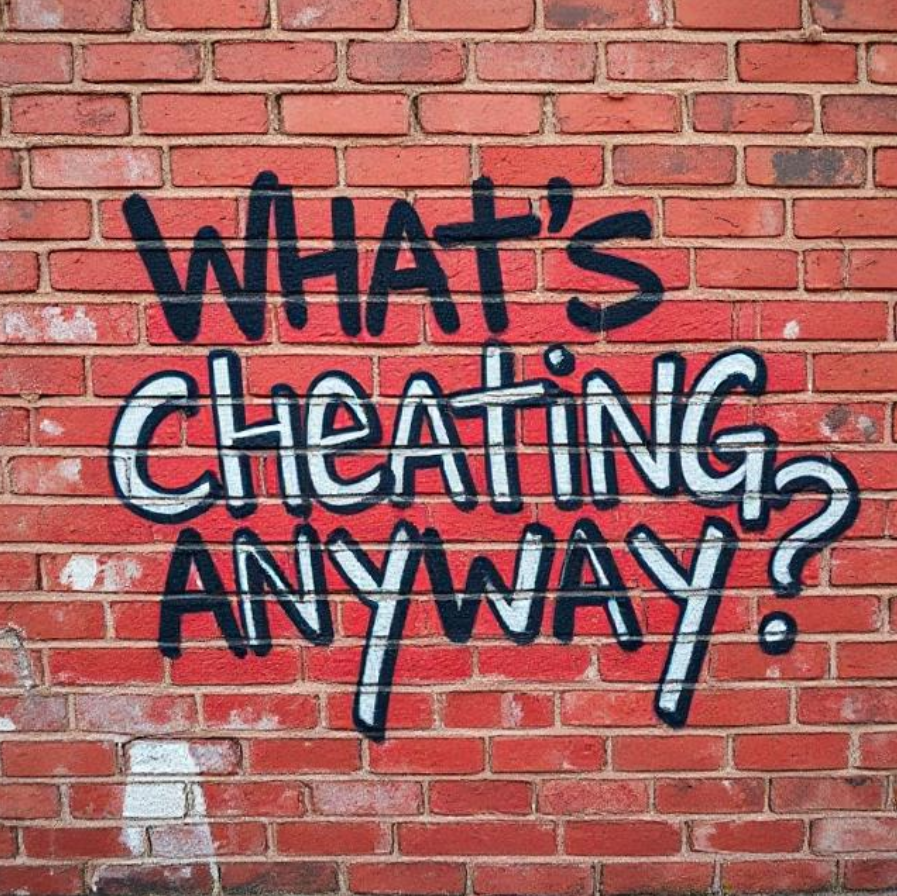
My point: There’s a danger we assume students will invariably cheat if given the chance. This meme challenges educators to reconsider what they define as cheating and encourages transparent, explicit dialogue around academic integrity. What will we lose if we assume all students are all about pulling a fast one?

My daughter (aged 13) suggested this one. How teachers view ChatGPT output: homogenised, overly polished essays lacking individuality. My daughter used the ‘who will be the next contestant on ‘The Bachelor’ (some reality show I am told) image to illustrate how teachers confidently claim they can spot AI-generated assignments because “they all look the same.” My point: I think this highlights early scepticism about AI-produced writing but that we should as educators consider the extent to which these tools have evolved beyond initial assumptions and remind our students (and ourselves) that imperfections and quirks can define a style. Just ask anyone reading one of my metaphor-stretched, overly complex sentences. Perhaps, for too long we have over-valued grammatical accuracy and formulaic writing?

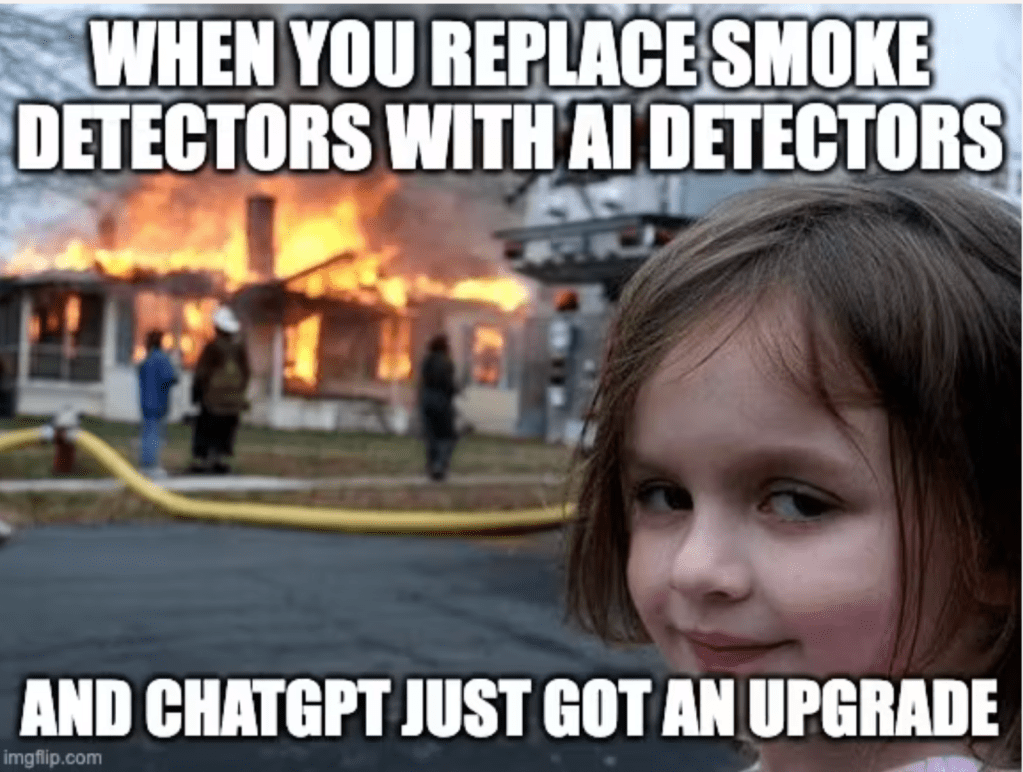
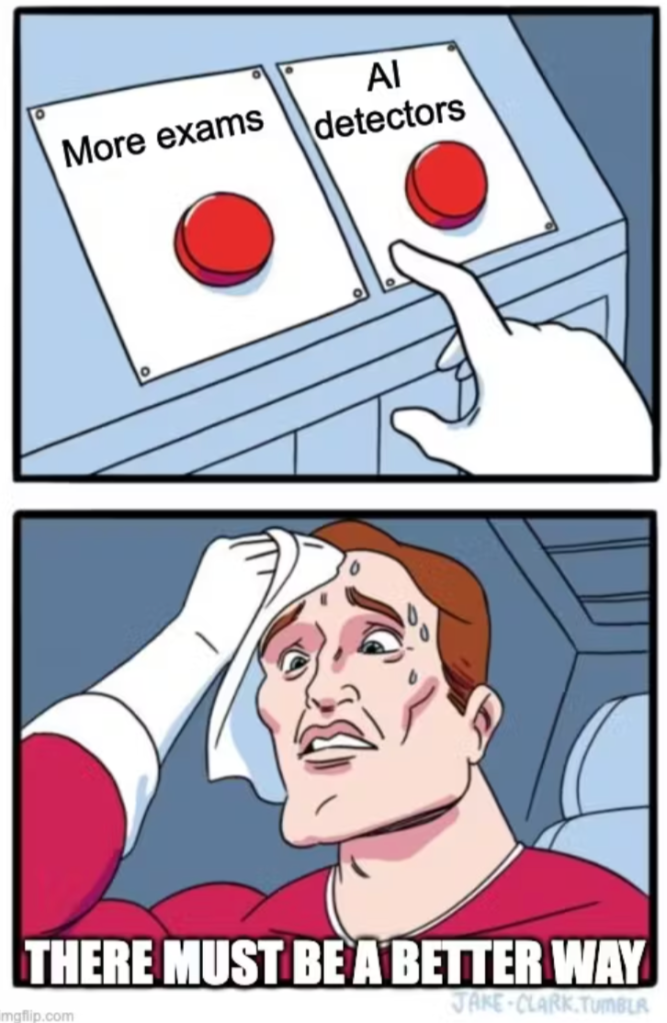
My point: It’s not just about AI detectors of course. It’s more that this is an arms race we can’t win. If we see big tech as our enemy then fighting back with more of their big tech makes no sense. If we see students as the enemy then we have a much bigger problem. Collective punishment and starting with an assumption of guilt are hugely problematic in schools/ unis much as they are in life and tyrannical societies in general. When it comes to revisiting academic integrity I am keen discuss what it is we are protecting. I am also very much drawn to Ellis and Murdoch’s ‘responsive regulation’ approach. I don’t think I’m quite on the same page regarding automated detection but I do agree regarding the application (and resourcing of) deserved sanction for the ‘criminal’ (willful cheats) along with efforts to widen self-regulation and move as many students as possible from carelessness (or chancer behaviours) to self-regulation is critical.

Pretty obvious I guess but my point is this: We also need to resist assumptions that all students prioritise grades over genuine learning and creativity. Yes, there are those who are wilfully trying to find the easiest path to the piece of paper that confirms a grade or a degree or whatever. Yes, there are those whose heads may be turned by the promise of a corner-cutting opportunity. But there are SO many more who want to learn, who are anxious because they know others who are being accused of using these tech inappropriately (because, for example, they use ‘big’ words… really, this has happened). ALSO, we need to challenge the structural features that define education in terms of employability and value. I know how to use chatgpt but I am writing this. Why am I bothering writing? Because I like it. Because – I hope- my writing, even when convoluted (much like this sentence) is more compelling. Because it’s more gratifying than the thing I’m supposed to be doing. Above all, for me, it’s because it actually helps me articulate my thoughts better. We must continue valuing intrinsic motivation and the joy students derive from learning and creating independently. But more than that: we need to face up to the systemic issues that drive more students towards corner cutting or willful cheating. By the way, I often use generated text in things I write. All the alt text in these images is AI generated (then approved / edited by me) for example.

This leads me to the next one. I mean I do use AI every day for translation, transcription, information management, easing access to information, reformatting, providing alternative media, writing alt text… Many don’t I know. Many refuse; I know this too. But we are way into majority territory here I think. Students are recognising this real (or imagined) hypocrisy. The only really valid response to this I have heard goes something like: ‘I can use it because I am educated to x level. first year undergrads do not have the critical awareness or developed voice to make an informed choice’. I mean, I think that may be the case to an extent or in some cases but it reminds me a bit of the ‘pen licences’ my daughter’s primary school issued: you get one when you prove you can use a pencil first (little Timmy, bless him, is still on crayons). Have you seen the data on student routine use of generative AI? It elevates the tool to some sort of next level implement but is it even? I think I could make a better case for normalisation and acceptance of a future where human / AI hybrid writing is just how it is done (as per Dr Sarah Eaton’s work- note the firve other elements in the tenets.)

My point: The narratives around essential changes we need to implement ‘because of AI’ presents a false dichotomy between reverting to traditional exam halls or relying solely on AI detection tools. Neither option adequately addresses modern academic integrity challenges. Exams can be as problematic and inequitable as AI detection. It is not a binary choice. There are other things that can be done. I’ll leave this one hanging a bit as it overlaps with the next one.

My point: We need to critically re-evaluate how and why essays are used in assessment. We can maintain the essay but evolve its form to better reflect authentic, inclusive and meaningful assessments rather than relying on traditional, formulaic, high-stakes versions. Anyway I (with Dr Claire Gordon) have said it before, we already have a manifesto and Dr Alicia Syskja takes the argument to the next level here.

Really, though, you should have been there; we had a great time.

But how? And why even? Practical examples of ways assessments have been modified

Modifying or changing assessment ‘because of AI’ always feels like it feeds ‘us and them’ narratives of a forthcoming apocalypse (already predicted) and couches the change as necessary only because of this insidious, awful thing that no-one wants except men in leather chairs who stroke white cats.

It is of course MUCH more complex than that and much of the desired change has been promoted by folk with a progressive, reform, equity, inclusion eye who do (or immerse themselves in) scholarship of HE pedagogy and assessment practices.

Anyway, a colleague suggested that we should have a collection of ideas about practical ways assessments could be modified to either make them more AI ‘robust’ or at least ‘AI aware’ or ‘ AI inclusive’ (I’m hesitant to say ‘resitant’ of course). Whilst colleagues across King’s have been sharing and experimenting it is probably true to say that there is not a single point of reference. We are in King’s Academy working on remedying this as part of the wider push to support TASK (transforming assessment for students at King’s) and growing AI literacy but first I wanted to curate a few examples from elsewhere to offer a point of reference for me and to share with colleagues in the very near future. I’ve gone for diversity from things I have previously book marked. Other than that, they are here only to offer points of discussion, inspiration, provocation or comparison!

Before I start I should remind KIng’s colleagues of our own guidance and the assessment principles therein, note that with collleagues at LSE, UCL and Southampton I am working on some guidance on the use of AI to assist with marking (forthcoming and controversial). Some of the College Teaching Fund projects looked at assessment and This AI Assessment Scale from Perkins et al. (2024) has a lot of traction in the sector too and is not so dissimilar from the King’s 4 levels of use approach. It’s amazing how 2023 can feel a bit dated in terms of resources these days but this document form the QAA is still relevant and applicable and sets out broader, sector level approarpriate principles. In summary:

  • Institutions should review and reimagine assessment strategies, reducing assessment volume to create space for activities like developing AI literacy, a critical future graduate attribute.
  • Promote authentic and synoptic assessments, enabling students to apply integrated knowledge practically, often in workplace-related settings, potentially incorporating generative AI.
  • Move away from traditional, handwritten, invigilated exams towards innovative approaches like digital exams, observed discipline-specific assessments or oral examinations
  • Design coursework explicitly integrating generative AI, encouraging ethical use, reflection, and hybrid submissions clearly acknowledging AI-generated content.
  • Follow guiding principles ensuring assessments are sustainable, inclusive, aligned to learning outcomes, and effectively demonstrate relevant competencies, including appropriate AI usage.

I’m also increasingly referring to the two lane approach being adopted by Sydney which leans heavily into similar principles. Context is different to UK of course but I have a feeling we will find ourselves moving much closer to the broad approach here. It feels radical but perhaps no more radical than what many, if not most, unis did in Covid.

Finally, the examples

Example 1. UCL Medical Sciences BSc.

  • Evaluation of coursework assessments to determine susceptibility to generative AI and potential integration of AI tools.
  • Redesign of assessments to explicitly incorporate evaluation of ChatGPT-generated outputs, enhancing critical evaluation skills and understanding of AI limitations.
  • Integration of generative AI within module curricula and teaching practices, providing formative feedback opportunities.
  • Collection of student perspectives and experiences through questionnaires and focus groups on AI usage in learning and assessments.
  • Shift towards rethinking traditional assessment formats (MCQs, SAQs, essays) due to AI’s impact, encouraging ongoing pedagogical innovation discussions.

Example 2 – Cardiff University Immunology Wars

  • Gamification: Complex immunology concepts taught through a Star Wars-inspired, game-based approach.
  • AI-driven game design: ChatGPT 4.0 used to structure game scenarios, resources, and dynamic challenges.
  • Visual resources with AI: DALLE-3 employed to create engaging imagery for learning materials.
  • Iterative AI prompting: An innovative method using progressive ChatGPT interactions to refine complex game elements.
  • Practical, collaborative learning: Students collaboratively trade resources to combat diseases, supported by iterative testing and refinement of the game.

Example 3 Traffic lights University Winsconsin Green Bay

The traffic light system they are implementing is reflected in these three sample assessments:

  1. Red light – prohibited
  2. Yellow light – limited use
  3. Green Light – AI embedded into the task

Example 4 Imperial Business School MBA group work

  • Integration of AI: The original essay task was redesigned to explicitly require students to use an LLM, typically ChatGPT.
  • The change: Individual component of wider collaborative task. Students submit both the AI-generated output (250 words) and a critical evaluation of that output (250 words) on what is unique about a business proposal.
  • Critical Engagement Emphasis: The new task explicitly focuses on students’ critical analysis of AI capabilities and limitations concerning their business idea.
  • Reflective Skill Development: Students prompted to reflect on, critique, and consider improvements or extensions of AI-generated content, enhancing their evaluative and adaptive skills.

3 for 1! Example 5 – Harvard

Create a fictional character and interview them

World building for creative writing

Historical journey

More to follow…

Also note:

Manifesto for the essay

Related article (Compton & Gordon, 2024)
 
Also see: (Syska, 2025)We tried to kill the essay

Old problem, new era

“Empirical studies suggest that a majority of students cheat. Longitudinal studies over the past six decades have found that about 65–87% of college students in America have admitted to at least one form of nine types of cheating at some point during their college studies”

(Yu et al., 2018)

Shocking? Yes. But also reassuring in its own way. When you are presented with something like that from 2018 (ie. pre chatgpt) you realise that this is not a newly massive issue; it’s the same issue with a different aspect, lens or vehicle. Cheating in higher education has always existed, but I do acknowledge that generative AI has illuminated it with an intensity that makes me reach for the eclipse goggles. There are those that argue that essay mills and inappropriate third party support were phenomena that we had inadequately addressed as a sector for a long time. LLMs have somehow opened a fissure in the integrity debate so large that suddenly everyone wants to do something about it. it has become so much more complex because of that but also that visibility could be seen positively (I may be reaching but I genuinely think there is mileage in this) not least because: 

1. We are actually talking about it seriously. 

2. It may give us leverage to effect long needed changes. 

The common narratives I hear are ‘where there’s a will, there’s a way’ and chatgpt makes the ‘way’ easier. The problem though, in my view, is that just because the ‘way’ is easier does not mean the ‘will’ will necessarily increase. Assuming all students will cheat does nothing to build bridges, establish trust or provide an environment where the sort of essential mutual respect necessary for transparent and honest working can flourish.  You might point to the stat at the top of this page and say we are WAY past the need to keep measuring will!  Exams, as I’ve argued before, are no panacea, given the long-standing issues of authenticity and inclusivity they bring (as well as being the place where students have shown themselves to be most creative in their subversion techniques!). 

In contrast to this, study after study is finding that students are increasingly anxious about being accused of cheating when that was never their intention. They report unclear and sometimes contradictory guidance, leaving them uncertain about what is and isn’t acceptable. A compounding  issue  is the lack of consistency in how cheating is defined. it varies significantly between institutions, disciplines and even individual lecturers. I often ask colleagues whether certain scenarios constitute cheating, deliberately using examples involving marginalised students to highlight the inconsistencies.  Is it ok to get structural, content or proof reading  suggestions from your family? How does your access to human support differ if you are a first generation, neurodivergent student studying in a new language and country? Policies usually say “no” but to fool ourselves that this sort of ‘cheating’ is not routine would be hard to achieve and even harder to evidence. The boundaries are blurred, and the lack of consensus only adds to the confusion.

To help my thinking on this I looked again at some articles on cheating over time (going back to 1941!) that I had put in a folder and badly labelled as per usual and selected a few to give me a sense of the what and how as well as the why and to provide a baseline to inform the context around the current assumptions about cheating. Yu et al. (2018) use a long established categorisation of types of cheating with a modification to acknowledge unauthorised digital assistance:

  1. Copying sentences without citation.
  2. Padding a bibliography with unused sources.
  3. Using published materials without attribution.
  4. Accessing exam questions or answers in advance.
  5. Collaborating on homework without permission.
  6. Submitting work done by others.
  7. Giving answers to others during an exam.
  8. Copying from another student in an exam.
  9. Using unauthorised materials in an exam.

The what and how question reveals plenty of expected ways of cheating, especially in exams but it is also noted where teachers / lecturers are surprised by the extent and creativity. Four broad types:

  1. Plagiarism in various forms from self, to peers to deliberate inappropriate practices in citation.
  2. Homework and assignment cheating such as copying work, unauthorised collaboration, or failing to contribute fairly.
  3. Other academic dishonesty such as falsifying bibliographies, influencing grading or contract cheating.
  4. In exams.

The amount of exam based cheating reported should really challenge assumptions about the security of exams at the very least and remind us that they are no panacea whether we see this issue through an ongoing or a chatgpt lens. Stevens and Stevens (1987) in particular share some great pre-internet digital ingenuity and Simpkin and McLeod (2006) show how the internet broadened the scope and potential. These are some of the types reported over time: 

  1. Using unauthorised materials.
  2. Obtaining exam information in advance.
  3. Copying from other students.
  4. Providing answers to other students.
  5. Using technology to cheat (using microcassettes, pre-storing data in calculators, mobile phones. Not mentioned but now apparently a phenomenon is use of bone conduction tech in glasses and/ or smart glasses).
  6. Using encoded materials (rolled up pieces of paper for example).
  7. Hiring a surrogate to take an exam.
  8. Changing answers after scoring (this one in Drake,1941)
  9. Collaborating during an exam without permission.

These are the main reasons for cheating across the decades I could identify (from across all sources cited at the end):

  1. Difficulty of the work. When students are on the wrong course (I’m sure we can think of many reasons why this might occur), teaching is inadequate or insufficiently differentiated.
  2. Pressure to succeed. ‘Success’ when seen as the principal goal can subdue the conscience.
  3. Laziness. This is probably top of many academics’ assumptions and it is there in the research but also worth considering what else competes for attention and time and how ‘I can’t be bothered’ may also mask other issues even in self-reporting. 
  4. Perception that cheating is widespread. If students feel others are doing it and getting away with it, it increases the cheating.
  5. Low risk of getting caught.
  6. Sense of injustice in systemic approach, structural inequalities both real and perceived can be seen as a valid justification. 
  7. External factors such as evident cheating in wider society. A fascinating example of this was suggested to me by an academic who was trained in Soviet dominated Eastern Europe who said cheating was (and remains) a marker of subversion so carries its own respectability)
  8. Lack of understanding of what is allowed and is not- students reporting they have not been taught this and degrees of cheating blurred by some of the other factors here- when does collaboration become collusion?
  9. Cultural influences. Different norms and expectations can create issues and this comes back to my point about individualised (or contextualised) definitions of what is and is not appropriate. 
  10. My own experiences, over 30 years, of dealing with plagiarism cases often reveals very powerful, often traumatic, experiences that lead students to act in ways that are perceived as cheating.

For each it’s worth asking yourself:

How much is the responsibility for this on the student and how much on the teacher/ lecturer and / or institution (or even society)?

I suspect that the truly willful, utterly cynical students are the ones least likely to self declare and are least likely to get caught. This furthers my own discomfort about the mechanisms we rely (too heavily?) on to judge integrity too.

This skim through really did make clear to me that cheating and plagiarism are not the simple concepts that many say they are. Also cheating in exams is a much bigger thing than we might imagine. The reasons for cheating are where we need to focus I think.  Less so the ‘how’ as that becomes a battleground and further entrenches ‘us and them’ conceptualisations.  When designing curricula and assessments the unavoidable truth is we need to do better by moving away from one size fits all approaches, by realising cultural, social and cognitive differences will impact many of the ‘whys’ and hold ourselves to account when we create or exacerbate structural factors that broaden likelihood of cheating. 

I am definitely NOT saying give wilful cheaters a free pass but all the work many universities are doing on assessment reform needs to be seen through a much longer lens than the generative AI one. To focus only on that is to lose sight of the wider and longer issue. We DO have the capacity to change things for the better but that also means that many of us will be compelled (in a tense, under threat landscape) to learn more about how to challenge conventions and even invest much more time in programme level, iterative, AI cognisant teaching and assessment practices. Inevitably the conversations will start with the narrow and hyped and immediate manifestations of inappropriate AI use but let’s celebrate this as leverage; as a catalyst.  We’d do well, at the very least, to reconsider how we define cheating, why we consider some incredibly common behaviours as cheating (is it collusion or is it collaboration for example or proof reading help from 3rd parties). Beyond that, we should be having serious discussions about augmentation and hybridity in writing: what counts as acceptable support? How does that differ according to context and discipline? It will raise questions about the extent to which writing is the dominant assessment medium, about authenticity in assessment and about the rationale and perceived value of anonymity. 

It’s interesting to read how over 80 years ago (Drake, 1941) many of the behaviours we witness today in both students and their teachers have 21st century parallels. Strict disciplinarian responses or ignoring it because ‘they’re only harming themselves’ being common. In other words, the underlying causes were not being addressed. To finish I think this sets out the challenge confronting us well:

“Teachers in general, and college professors in particular, will not be enthusiastic about proposed changes. They are opposed to changes of any sort that may interfere with long- established routines-and examinations are a part of the hoary tradition of the academic past”

(Drake, 1941, p.420)

Drake, C. A. (1941). Why students cheat. Journal of Higher Education, 12(5)

Hutton, P. A. (2006). Understanding student cheating and what educators can do about it. College Teaching, 54(1), 171–176. https://www.jstor.org/stable/27559254 

Miles, P., et al. (2022). Why Students Cheat. The Journal of Undergraduate Neuroscience Education (JUNE), 20(2):A150-A160 

Rettinger, D. A., & Kramer, Y. (2009). Situational and individual factors associated with academic dishonesty. Research in Higher Education, 50(3), 293-313. https://doi.org/10.1007/s11162-008-9116-5 

Simkin, M. G., & McLeod, A. (2010). Why do college students cheat?. Journal of Business Ethics, 94, 441-453. https://doi.org/10.1007/s10551-009-0275-x 

Stevens, G. E., & Stevens, F. W. (1987). Ethical inclinations of tomorrow’s managers revisited: How and why students cheat. Journal of Education for Business, 63(1), 24-29. https://doi.org/10.1080/08832323.1987.10117269 

Yu, H., Glanzer, P. L., Johnson, B. R., Sriram, R., & Moore, B. (2018). Why college students cheat: A conceptual model of five factors. The Review of Higher Education, 41(4), 549-576. https://doi.org/10.1353/rhe.2018.0025 

Gallant, T. B., & Drinan, P. (2006). Organizational theory and student cheating: Explanation, responses, and strategies. The Journal of Higher Education, 77(5), 839-860. https://www.jstor.org/stable/3838789 

CPD for critical AI literacy: do NOT click here.

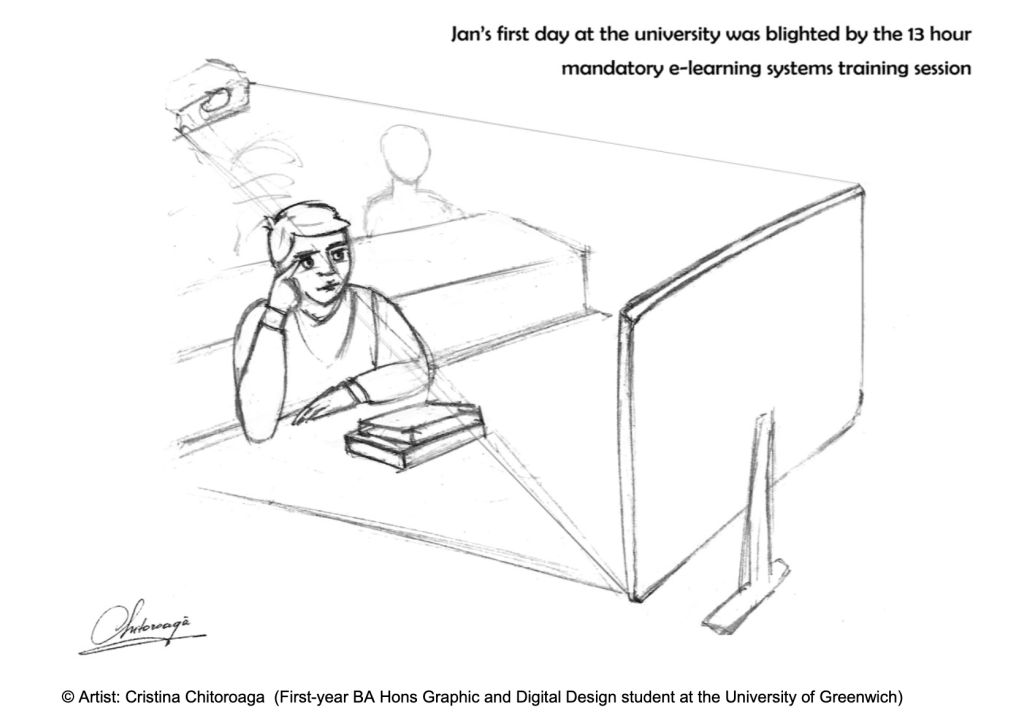
In 2018, Timos Almpanis and I co-wrote an article exploring issues with Continuous Professional Development (CPD) in relation to Technology Enhanced Learning (TEL). The article, which we published while working together at Greenwich (in Compass: Journal of Learning and Teaching), highlighted a persistent challenge: despite substantial investment in TEL, enthusiasm for it and use among educators remained inconsistent at best. While students increasingly expect technology to enhance their learning, and there is/ was evidence to supports its potential to improve engagement and outcomes, the traditional transmissive CPD models supporting how teaching academics were introduced to TEL and supported in it could undermine its own purpose. Focusing on technology and systems as well as using poor (and non modelling) pedagogy often gave/ give a sense of compliance over pedagogic improvement.

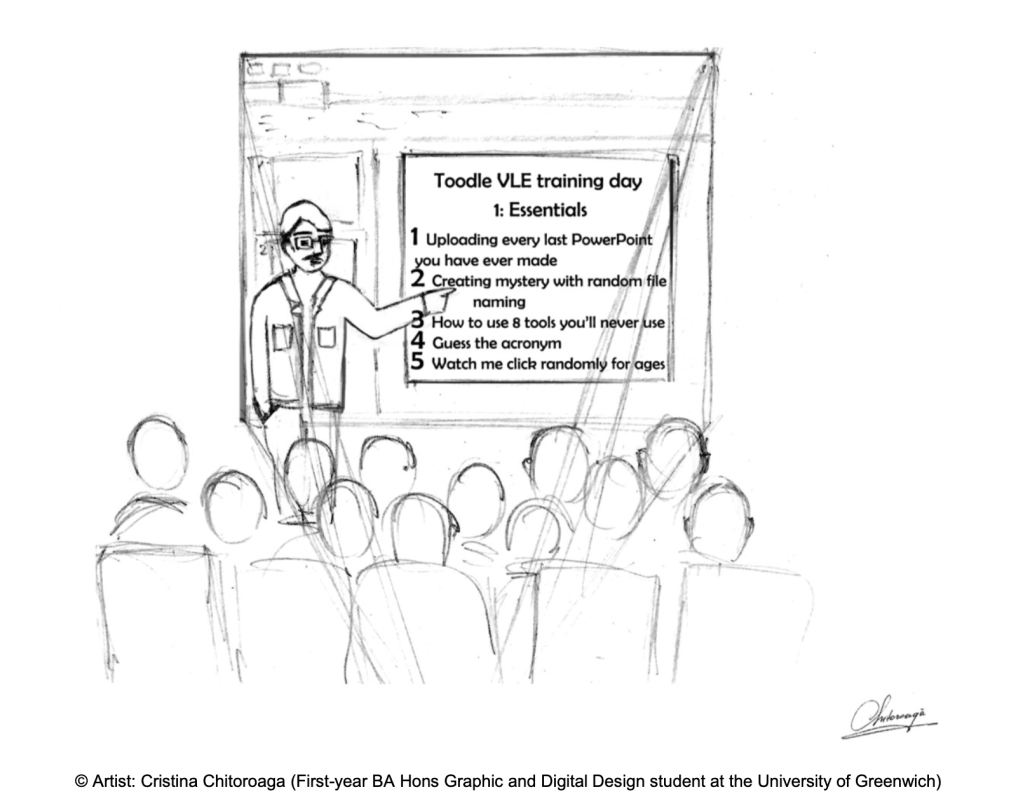
Because we are both a bit contrary and subversive we commissioned an undergraduate student (Christina Chitoroaga) to illustrate our arguments with some cartoons which I am duplicating here (I think I am allowed to do that?):

We argued that TEL focussed CPD should prioritise personalised and pedagogy-focused approaches over one-size-fits-all training sessions. Effective CPD that acknowledges need, relfects evidence-informed pedagogic apparoaches and empowers educators by offering choice, flexibility and relevance, will also enable them to explore and apply tools that suit their specific teaching contexts and pedagogical needs. By shifting the focus away from the technology itself and towards its purpose in enhancing learning, we can foster greater engagement and creativity among academic staff. This was exactly the approach I tried to apply when rolling out Mentimenter (a student response system to support increasing engagement in and out of class).

I was reminded of this article recently (because fo the ‘click here; clck there’ cartoon) when a colleague expressed frustration about a common issue they observed: lecturers teaching ‘regular’ students (I always struggle with this framing as most of my ‘students’ are my colleagues- we need a name for that! I will do a poll – got totally distracted by that but it’s done now) how to use software using a “follow me as I click here and there” method. Given that the “follow me as I click” is still a thing, perhaps it is time to adopt a more assertive and directive approach. Instead of simply providing opportunities to explore better practices, we may need to be clearer in saying: “Do not do this.” I mean I do not want to be the pedagogy police but while there is no absolute right way there are some wrong ways, right? Also we might want to think about what this means in terms of the AI elephant in every bloomin’ classroom.

The deluge of AI tools and emerging uses of these tech (willingly and unwillingly & appropriately and inappropriately) means the need for effective upskilling is even more urgent. However we support skill development and thinking time we need of course to realise it requires moving beyond the “click here, click there” model. In my view (and I am aware this is contested) educators and students need to experiment with AI tools in real-world contexts, gaining experience in how AI is impacting curricula, academic use and, potentially, pedagogic practices. The many valid and pressing reasons why teachers might resist or reject engaging with AI tools: workload, ethical implications, data privacy, copyright, eye-watering environmental impacts or even concern about being replaced by technology are a significant barriers to adoption. But adoption is not my goal; critical engagement is. The conflation of the two in the minds of my colleagues is I think a powerful impediment before I even get a chance to bore them to death with a ‘click here; click there’. In fact, there’s no getting away from the necessity of empathy and a supportive approach, one that acknowledges these fears while providing space for dialogue and both critical AND creative applications of responsibly used AI tools. In fact, Alison Gilmour and I wrote about this too! It’s like all my work actually coheres!

Whatever the approach, CPD cannot be a one-size-fits-all solution, nor can it rely on prescriptive ‘click here, click there’ methods. It must be compassionate and dialogic, enabling experimentation across a spectrum of enthusiasm—from evangelical to steadfast resistance. While I have prioritised ‘come and play’, ‘let’s discuss’, or ‘did you know you can…’ events, I recognise the need for more structured opportunities to clarify these underpinning values before events begin. If I can find a way to manage such a shift it will help align the CPD with meaningful, exploratory engagement that puts pedagogy and dialogue at the heart of our ongoing efforts to grow critical AI literacy in a productive, positive way that offers something to everyone wherever they sit of the parallel spectrums of AI skills and beliefs.

Post script: some time ago I wrote on the WONKHE blog about growing AI literacy and this coincided wiht the launch of the GEN AI in HE MOOC. We’re working on an expanded version- broadening the scope of AI beyond the utterly divisive ‘generative’ as well as widening the scope to other sectors of education. Release due in May. It’ll be free to access.

AI positions: Where do you stand?

I have been thinking a lot recently about my own and others’ positions in relation to AI in education. I’m reading a lot more from the ‘ResistAI’ lobby and share many persepctives with core arguments. I likewise read a lot from the tech communities and enthusiastic educator groups which often get conflated but are important to distinguish given bloomin’ obvious as well as more subtle agenda and motivation differences (see world domination and profit arguments for example). I see willing adoption, pragmatic adoption, reluctant adoption and a whole bunch of ill-informed adoption/ rejection too. My reality is that staff and students are using AI (of different types) in different ways. Some of this is ground-breaking and exciting, some snag-filled and disappointing, some ill-advised and potentially risky. Exisiting IT infrastrucutre and processes are struggling to keep pace and daily conversations range from ‘I have to show you this- it’s going to change my life! ‘ to ‘I feel like I’m being left behind here’ and a lot more besides.

So it was that this morning I saw a post on LinkedIn (who’d have thought the place where we put our CVs would grow so much as an academic social network?) from Leon Furze who defines his position as ‘sitting on the fence’. I initially I thought ‘yeah that’s me’ but, in fact, I am not actually sitting on the fence at all in this space. I am trying as best I can to navigate a path that can be defined by the broad two word strategy we are trying define and support at my place: Engage Responsibly. Constructive resitance and debate are central but so is engagement with fundamental ideas, technologies, principles and applications. I have for ages been arguing for more nuanced understanding. I very much appreciate evidence and experiential based arguments (counter and pro). The waters are muddied though with, on the one hand, big tech declarations of educational transformation and revolution (we’re always on the cusp, right?) and sceptical generalisations like the one I saw gaining social media traction the other day which went something like:

“Reading is thinking

Writing is thinking

AI is anti-thinking”

If you think that then you are not thinking in my view. Each of those statements must be contextualised and nuanced. This is exactly the kind of meme-level sound bite that sounds good initially but is not what we should be entertaining as a position in academia. Or is it? Below are some adjectives and defintions of the sorts of positions identified by Leon Furze in the collection linked above and by me and research partners in crime Shoshi, Olivia and Navyasara. Which one/s would you pick to define your position? (I am aware that many of these terms are loaded; I’m just interested in the broadest sense where people see themselves, whether they have planted a flag or if they are still looking for a spot as they wander around in the traffic wide eyed).

  • Cautious: Educators who are cautious might see both the potential benefits and risks of AI. They might be hesitant to fully embrace AI without a thorough understanding of its implications.
  • Critical: Educators who are critical might take a stance that focusses on one or more of the ethical concerns surrounding AI and its potential negative impacts, such as the risk of AI being used for surveillance or control, or ways in which data is sourced or used.
  • Open minded: Open minded educators might be willing to explore AI’s possibilities and experiment with its use in education, while remaining aware of potential drawbacks.
  • Engaged: Engaged educators actively seek to understand AI, its capabilities and its implications for education. They seek to shape the way AI is used in their field.
  • Resistant: Resistant educators might actively oppose the integration of AI into education due to concerns about its impact on teaching, learning or ethical considerations.
  • Pragmatic: Pragmatic educators might focus on the practical applications of AI in education, such as using it for administrative tasks or to support personalised learning. They might be less concerned with theoretical debates and more interested in how AI can be used to improve their practice.
  • Concerned: Educators who are concerned might primarily focus on the potential negative impacts of AI on students and educators. They might worry about issues like data privacy, algorithmic bias, or the deskilling of teachers.
  • Hopeful: Hopeful educators might see AI as a tool that can enhance education and create new opportunities for students and teachers. They might be excited about AI’s potential to personalise learning, provide feedback and support students with diverse needs.
  • Sceptical: Sceptical educators might question the claims made about AI’s benefits in education and demand evidence to support its effectiveness. They might be wary of the hype surrounding AI and prefer to wait for more research before adopting it.
  • Informed: Informed educators would stay up-to-date with the latest developments in AI and its applications in education. They would understand both the potential benefits and risks of AI and be able to make informed decisions about its use.
  • Fence-sitting: Educators who are fence-sitting recognise the complexity of the issue and see valid arguments on both sides. They may be delaying making a decision until more information is available or a clearer consensus emerges. This aligns with Furze’s own position of being on the fence, acknowledging both the benefits and risks of AI.
  • Ambivalent: Educators experiencing ambivalence might simultaneously hold positive and negative views about AI. They may, for example, appreciate its potential for personalising learning but be uneasy about its ethical implications. This reflects cognitive dissonance, where conflicting ideas create mental discomfort. Furze’s exploration of both the positive potential of AI and the reasons for resisting it illustrates this tension.
  • Time-poor: Educators who are time-poor may not have the capacity to fully (or even partially) research and understand the implications of AI, leading to delayed decisions or reliance on simplified viewpoints.
  • Inexperienced: Inexperienced educators may lack the background knowledge to confidently assess the potential benefits and risks of AI in education, contributing to hesitation or reliance on the opinions of others.
  • Other: whatever the heck you like!

How many did you choose?

Please select two or three and share them via this Mentimeter Link.

I’ll share the responses soon!

AI in healthcare pulse check

I have been interested recently in the ways in which AI is being integrated into healthcare as part of my personal goal to widen my understanding and broaden my own definition of AI. I’m seeing increasing need to do this as part of growing awareness and literacy as well as a need to show that AI is impacting curricula well beyond the ongoing kerfuffle around generative AI and assessment integrity. I was recommended this panel by Professor Dan Nicolau Jr who chaired this session at the recent event which looked at the many barriers to advances in a context where early detection, monitoring, business models and data availability impact the ways in which we do medicine and advance it in a world where ageing populations present an existential threat to global healthcare systems. It struck me when I watched this how much the potentials and barriers expressed here will likely be mirrored in other disciplines. Medicine does seem to be an effective bellweather though.

Some of the issues that stood out:

Data availability and validity: Just as healthcare AI can produce skewed results from over-represented organisms in protein design, we see similar issues of data bias emerging across AI applications. The challenges around electronic health records – inconsistent, incomplete and error-prone – mirror concerns about data quality in other domains.

Business models and willingness/ ability to use what is available: The difficulty in monetising preventative AI applications in medicine, for example, reflects broader questions about how we value different types of AI innovation. Similarly, the need to shift mindsets from reactive to proactive approaches in healthcare has parallels with cultural change required for effective AI adoption elsewhere. The comments from the panel about human propensities NOT to use devices or take medicines that will help them are quite shocking but still somehow unsurprising. Cracking that, according to the panel, would increase life expectancy more than finding a cure for cancer.

The regulatory landscape: The NHS’s procurement processes, which can stifle AI innovation, demonstrate how existing institutional frameworks may need significant adaptation. This raises important questions about how we balance innovation with appropriate oversight – something all sectors grappling with AI must address.

For me, healthcare exemplifies the complex relationship between technical capability and human behaviour. The adoption issue is obviously one that has parallels with willingness/ openness to using novel technologies, even where they can be shown to make life better or easier. The panel’s observations about patient compliance mirror wider challenges around user adoption and engagement with AI systems. We cannot separate the technology from the human context in which it operates.

Bots with character

This is a swift intro to character AI *(note 1)- a tool that is available to use for free currently (on a freemium model). My daughter showed it to me some months ago. It appears as a novelty app but is used (as I understand it) beyond entertainment for creative activity, gaming, role playing and even emotional support. For me it is the potential to test ideas that many have about bot potential for learning that is most interesting. By shifting focus away from ‘generating essays’ it is possible to see the appeal of natural language exchanges to augment learning in a novel medium. While I can think of dozens of use cases based on the way I currently (for example) use YouTube to help me to learn how to unblock a washing machine I imagine that is a continuum that goes all the way up to teacher replacement.*(note 2) Character AI is built on large language model, employs ‘reinforcement’ (learning as coversations continue) and provides an easy to learn interface (basically typing stuff in boxes) that allows you to ground the bot with ease in a wysiwyg interface.

As I see it, it offers three significant modifications in the default interface to standard (free) LLMs. 1. You can create characters and define their knowledge and ‘personality’ traits by having space to ground the bot behaviour through customisation. 2. You can have voice exchanges by ‘calling’ the character. 3. Most importantly, it shifts the technology back to interaction and away from lengthy generation (though they can still go on a bit if you don’t bake succinctness in!) What interests me most is the potential to use tools like this to augment learning, add some novelty and provide reinforcement opportunity through text or voice based exchanges. I have experimented with creating some academic architypes for my students to converse with. This one is a compassionate pedagogue, this one is keen on AI for teaching and learning, this one a real AI sceptic, this one deeply worried about academic integrity. They each have a back story, defined university role and expertise. I tried to get people to test arguments and counter arguments and to work through difficult academic encounters. It’s had mixed reviews so far: Some love it; some REALLY do not like it at all!

How do/ could you use a tool like this?

Note 1. This video in no way connotes promotion or recommendation (by me or by my employer) of this software. Never upload data you are not comfortable sharing and never upload your own or other’s personal data.

Note 2: I am not a proponent of this! There may be people who think this is the panacea to chronic educational underfunding though so beware.