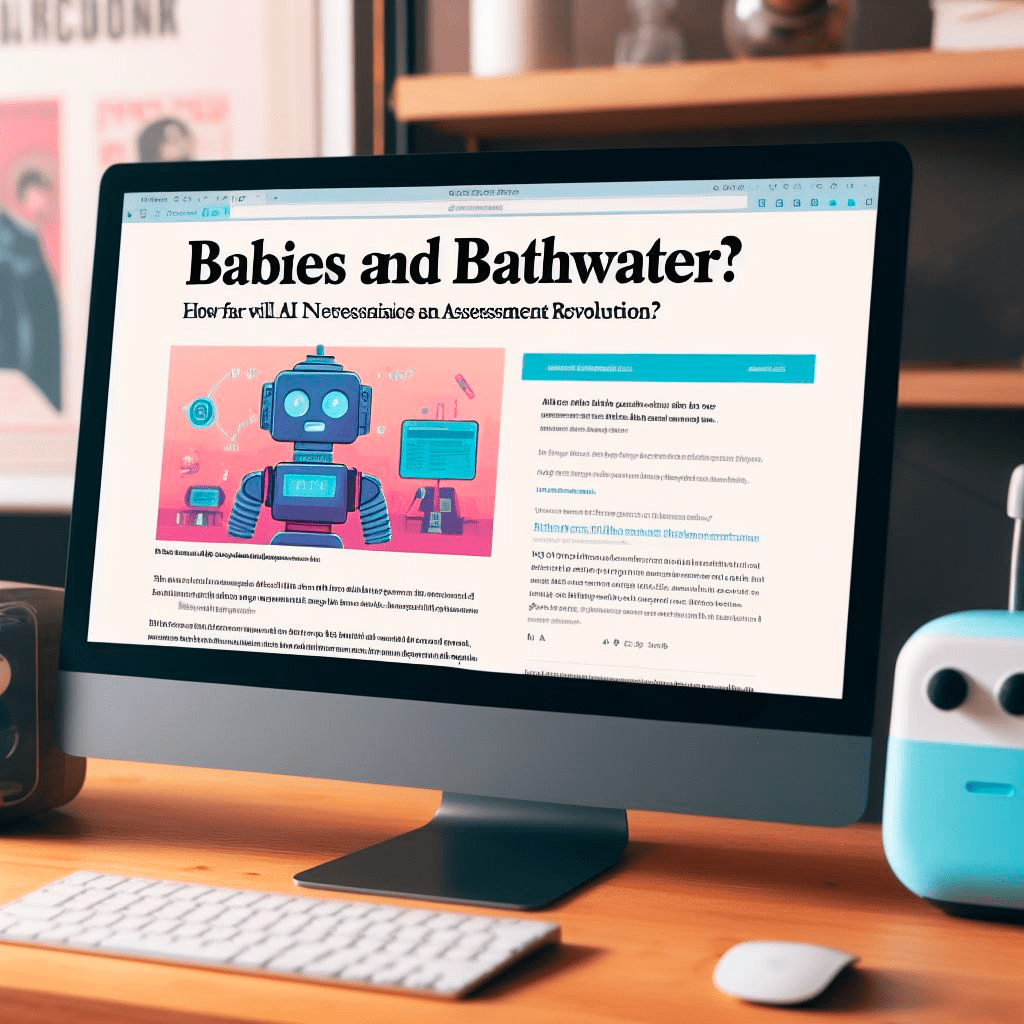
What will assessment look like in universities in 2033? There’s a lot of talk about how AI may finally catalyse long-needed changes to a lot of the practices we cling to but there’s also a quite significant clamour to do everything in exam halls. Amidst the disparate voices of change are also those that suggest we ride this storm out and carry on pretty much as we are: it’s a time-served and proven model, is it not?
Anyway, by way of provocation, see below four visions of assessment in 2033. What do you think? Is one more likely? Maybe bits of two or more or none of the below? What other possibilities have I missed?
- Assessment 2033: Panopticopia
Alex sat nervously in a sterile examination room, palms clammy, heart pounding, her personal evaluation number stamped on each hand and her evaluation tablet. The huge digits on the all-wall clock counted down ominously. As she began the timed exam, micro-drones buzzed overhead, scanning for unauthorised augmentations and communications. Proctoring AI software tracked every keystroke and eye movement, erasing any semblance of privacy. The relentless pressure to recall facts and formulas within seconds elevated her already intense anxiety. Alex knew she was better than these exams would suggest but in the race against technology ideals like fairness, inclusive practice and assessment validity were almost forgotten.
- Assessment 2033: Nova Lingua
Karim sat, feet up, in the study pod on campus, ready to tackle his latest essay. Much of the source material was in his first language so he felt confident the only translation tech he’d need would be with his more whimsical flourishes (usually in the intro and conclusion). He activated ‘AiMee’, his assistant bot, instructed her to open Microsoft Multi-Platform and set the essay parameters: ‘BeeLine text with synthetic voiced audio and an AI avatar presented digest’. AiMee processed the essay brief as Karim scanned it in and started the conversation. Karim was pleased as his thoughts appeared as eloquent prose, simultaneously in both his first language and the two official university languages. As he worked, Karim thought ruefully about how different an education his parents might have had given that they both, like him, were dyslexic.
- Assessment 2033: Nova Aurora
Jordan was flushed with delight at the end of their first term on the flexible, multi-modal ‘stackable’ degree. It was amazing to think how different it was from their parents’ experience. There were no traditional exams or strict deadlines. Instead, they engaged in continuous, project and problem-based learning. Professors acted as mentors, guiding them through iterative processes of discovery and growth. The emphasis was on individual development, not just the final product. Grades were replaced with detailed feedback, fostering an appreciation for learning for its own sake rather than competition or -what did their mum call it? ‘Grade grubbing’! Trust was a defining characteristic of academic and student interactions with collaboration highly valued and ‘collusion’ an obsolete concept. HE in the UK had somehow shifted from a focus on evaluation and grades to nurturing individual potential, mirrored by dynamic, flexible structures and opportunities to study in many ways, in many institutions and in ways that aligned with the complexities of life.
- Assessment 2033: Plus ça change
Ash sighed as she hunched over her laptop, typing furiously to meet another looming deadline. In 2033, it seemed that little had changed in higher education. Universities clung stubbornly to old assessment methods, reluctant to adapt. Plagiarism and AI detection tools remained easy to circumvent, masking the harsh realities of how students and, with similar frequency, academic staff, relied on technologies that a lot of policy documents effectively banned. The obsession with “students’ own words” pervaded every conversation, drowning out the unheard lobby advocating for a deeper understanding of students’ comprehension and wider acceptance of the realities of new ways of producing work. Ash knew that she wasn’t alone in her frustrations. The system seemed intent on perpetuating the status quo, turning a blind eye to the disconnect between the façade of academic integrity and the hidden truth of how most students and faculty navigated the system.