AI3*: Crossing the streams of artificial intelligence, academic integrity and assessment innovation

*That’s supposed to read AI3 but the title font refuses to allow superscript!

Yesterday I was delighted to keynote at the Universities at Medway annual teaching and learning conference. It’s a really interesting collaboration of three universities: University of Greenwich, University of Kent and Canterbury Christchurch University. Based at the Chatham campus in Medway you can’t help but notice the history the moment you enter the campus. Given that I’d worked at Greenwich for five years I was familiar with the campus but, as was always the case when I went there during my time at Greenwich, I experienced a moment of awe when seeing the campus buildings again. It’s actually part of the Chatham Dockyard World Heritage site and features the remarkable Drill Hall library. The reason I’m banging on about history is because such an environment really underscores for me some of those things that are emblematic of higher education in the United Kingdom (especially for those that don’t work or study in it!)

It has echoes of cultural shorthands and memes of university life that remain popular in representations of campus life and study. It’s definitely a bit out of date (and overtly UK centric) like a lot of my cultural references, but it made me think of all the murders in the Oxford set crime drama ‘Morse’.  The campus locations fossilised for a generation the idea of ornate buildings, musty libraries and deranged academics. Most universities of course don’t look like that and by and large academics tend not to be too deranged. Nevertheless we do spend a lot of time talking about the need for change and transformation whilst merrily doing things the way we’ve done them for decades if not hundreds of years. Some might call that deranged behaviour. And that, in essence, was the core argument of my keynote: For too long we have twiddled around the edges but there will be no better opportunity than now with machine-assisted leverage to do the things that give the lie to the idea that universities are seats of innovation and dynamism. Despite decades of research that have helped define broad principles for effective teaching, learning, assessment and feedback we default to lecture – seminar and essay – report – exam across large swathes of programmes. We privilege writing as the principle mechanism of evidencing learning. We think we know what learning looks like, what good writing is, what plagiarism and cheating are but a couple of quick scenarios to a room full of academics invariably reveal lack of consensus and a mass of tacit, hidden and sometimes very privileged understandings of those concepts.

Employing an undoubtedly questionable metaphor and unashamedly dated (1984) concept of ‘crossing the streams’ from the original Ghostbusters film, I argued that there are several parallels to the situation the citizens of New York first found themselves in way back when and not least the academics (initially mocked and defunded) who confront the paranormal manifestations in their Ghostbusters guises. First are the appearances of a trickle of ghosts and demons followed by a veritable deluge. Witness ChatGPTs release, the unprecedented sign ups and the ensuing 18 months wherein everything now has AI (even my toothbrush).   There’s an AI for That has logged 12,982 AIs to date to give an indication of that scale (I need to watch the film again to get an estimate on number of ghosts). Anyway, early in the film we learn that a Ghost catching device called a ‘Proton Pack’ emits energy streams but:


“The important thing to remember is that you must never under any circumstances, cross the streams.” (Dr Egon Spengler)

Inevitably, of course, the resolution to the escalating crisis is the necessity of crossing the streams to defeat and banish the ghosts and demons. I don’t think that generative AI is something that could or should be defeated and I definitely do not think that an arms race of detection and policing is the way forward either. But I do think we need to cross the streams of the three AIs: Artificial Intelligence; Academic Integrity and Assessment Innovation to help realise the long-needed changes.

Artificial Intelligence represents the catalyst not the reason for needing dramatic change.

Academic Integrity as a goal is fine but too often connotes protected knowledge, archaic practices, inflexible standards and a resistance to evolution.

Assessment innovation is the place where we can, through common language and understanding, address the concerns of perhaps more traditional or conservative voices about perceived robustness of assessments in a world where generative AI exists and is increasingly integrated into familiar tools along with what might be seen as more progressive voices who, well before ChatGPT, were arguing for more authentic, dialogic, process-focussed and, dare I say it, de-anonymised and humanly connected assessments.

Here is our opportunity. Crossing the streams may be the only way we mitigate a drift to obsolescence! MY concluding slide showed a (definitely NOT called Casper) friendly ghost which, I hope, connoted the idea that what we fear is the unknown but as we come to know it we find ways to shift from engagement (sometimes aggressively) to understanding and perhaps even an ‘embrace’ as many who talk of AI encourage us to do.

Incidentally, I asked the Captain (in my custom bot ‘Teaching Trek: Captain’s Counsel’) a question about change and he came up with a similar metaphor:

Blow Up the Enterprise: Sometimes, radical changes are necessary. I had to destroy the Enterprise to save my crew in “Star Trek III: The Search for Spock.” Academics should learn when to abandon a failing strategy and embrace new approaches, even if it means starting over.”

In a way I think I’d have had an easier time if I’d stuck with Star Trek metaphors. I was gratified to note that ‘The Search for Spock’ was also released in 1984. An auspicious year for dated cultural references from humans and bots alike.

—————–

Thanks:

The conference itself was great and I am grateful to Chloe, Emma, Julie and the team for orgnaising it and inviting me.

Earlier in the day I was inspired by presentations by colleagues from the three universities: Emma, Jimmy, Nicole, Stuart and Laura. The student panel was great too- started strongly with a rejection of the characterisation of students as idle and disintersted and carried on forcefully from there! And special thanks too to David Bedford (who I first worked with something like 10 years ago) who uses an analytical framework of his own devising called ‘BREAD’ as an aid to informing critical information literacy. His session adapted the framework for AI interactions and it prompted a question which led, over lunch, to me producing a (rough and ready) custom GPT based on it.

I should also acknowledge the works I referred to: 1. Sarah Eaton whose work on the 6 tenets of post-plagiarism I heartily recommended and to 2. Cath Ellis and Kane Murdoch* for their ‘enforcement pyramid’ which also works well as one of the vehicles that will help us navigate our way from the old to the new.

*Recommendation of this text does not in any way connote acceptance of Kane’s poor choice when it comes to football team preference.

Babies and Bathwater: How Far Will AI Necessitate an Assessment Revolution?

By Martin Compton & Chris Rowell

Recast version (auto podcast)

Caveat: This two-for-one post was generated using multiple AI technologies. It is drawn from the transcript of an event held this afternoon ( 6th October 2023) which was the first in a series of conversations about AI hosted by Chris Rowell at UAL. We thought it would be an interesting experiment to produce a blog summary of the key ideas and themes but then we realised that it was Friday afternoon and we both have lives too. So… we put AI tools to work: first MS Teams AI provided an instant transcript, then Claude AI filtered the content and separated it into two main chunks (Martin answering questions and then open discussion). Third we used the prompt in ChatGPT: Using the points made by Martin Compton write a blog post of 500-750 words that captures the key points he raises in full prose, using the style and tone he uses here. Call the post ” Babies and bathwater: how far will AI necessitate an assessment revolution?” . Then, we did something similar with the open discussion and that led to part two of this post below. Finally, I used some keywords to generate some images in Bing Chat which uses Dall-e 3 to decorate the text.

Part 1: The conversation

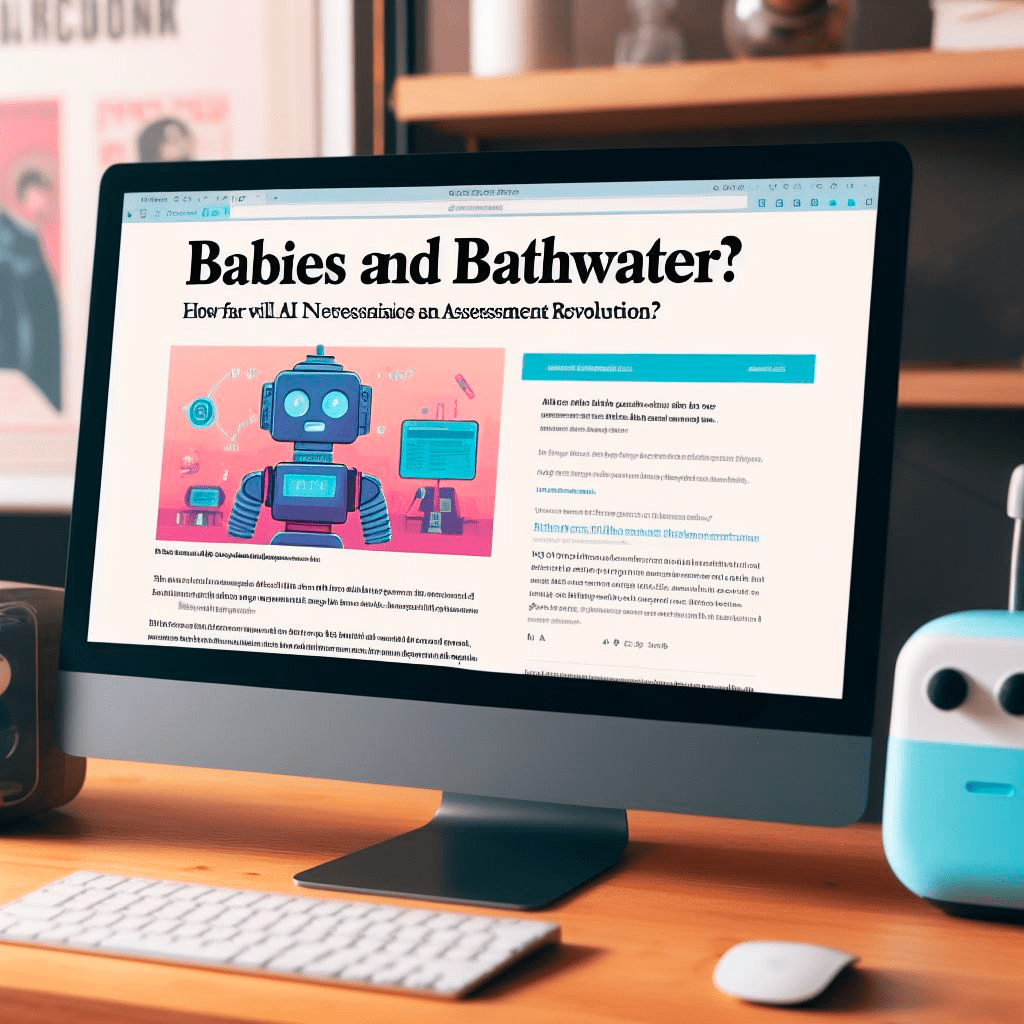
Attempt 1: AI generated image (Using Dall-e3 via Bing Chat) of computer monitor showing article called ‘Babies and Bathwater’ below which is an image of two babies in a sort of highchair/ bath combo

The ongoing dialogue around AI’s influence on education often has us pondering over the depth and dimensions of the issue. Our peers frequently express their concerns about students using AI to craft essays and generate images for their assessments. Recently, I (Chris) stumbled upon the AI guidelines by King’s, urging institutions to enable students and staff to become AI literate. But the bigger question looms large: what does being AI literate truly entail?

Attempt 2: AI generated image (Using Dall-e3 via Bing Chat) of computer monitor showing article called ‘Babies and Bathwater?’ below which is an image of a robot

For me (Martin), this statement from the Russell Group principles on generative AI has been instrumental in persuading some skeptics in the academic realm of the necessity to engage. It’s clear that AI literacy isn’t just another buzzword. It’s a doorway to stimulating dialogue. It’s about addressing our anxieties and reservations, then channeling those emotions to drive conversations around teaching, assessment, and learning.

Truth be told, when we dive deep into the matter of AI literacy, we’re essentially discussing another facet of information literacy. It’s a skill we aim to foster in our students and one that, as educators, we should continually refine in ourselves. Yet, I often feel that the larger academic community might not be doing enough to hone these skills, especially in the digital age where misinformation spreads like wildfire.

With the rise of AI technologies like ChatGPT, I was both amazed and slightly concerned. The first time I tested it, the results left me in awe. However, on introspection, I realized that if an AI can flawlessly generate a university-level essay, then it’s high time we scrutinized our assessments. It’s not about the capabilities of AI; it’s about reassessing the nature and objectives of our examinations.

When my colleagues seek advice on navigating this AI-augmented educational landscape, my primary counsel is simple: don’t panic. Instead, let’s critically analyze our current assessment methodologies. Our focus should pivot from regurgitation of facts to evaluating understanding and application. And if a certain subject demands instant recall of information, like in medical studies, we should stick to time-constrained evaluations.

Attempt 3: AI generated image (Using Dall-e3 via Bing Chat) of computer monitor showing article called ‘Babies and Bathnwater [sic] below which is an image of some very disturbingly muscled babies

To make our existing assessments less susceptible to AI, it’s crucial to reflect on their core objectives. This takes me back to the fundamental essence of pedagogy, where we need to continuously question and redefine our approach. Are we merely conducting assessments as a formality, or are they genuinely driving learning? It’s imperative to emphasize the process as much as the final output.

Now, if you ask me whether we should incorporate AI into our summative assessments, my perspective remains fluid. While today it might seem like a radical notion, in the future, it could be as commonplace as using the internet for research. But while we’re in this transitional phase, understanding and integrating AI should be done judiciously.

Lastly, when it comes to AI-generated feedback for students, I believe there’s potential, albeit with certain limitations. There’s undeniable value in students receiving feedback from various sources. Yet, we must tread cautiously to ensure academic integrity.

In essence, as educators and advocates of lifelong learning, we must embrace the challenges AI brings to our table, approach them with a critical lens, and adapt our strategies to nurture an equitable, AI-literate generation.

Part 2: Thoughts from the (bathroom) floor: Assessing Process Over Product in the Age of AI

The following is a synthesis of comments made during the discussion that ensued after the intial Q & A conversation.

Valuing Creation Process over End Product

There’s been a long-standing tradition in education of assessing the final product. Be it a project, an essay, or a painting, the emphasis has always been on the end result. But isn’t the journey as significant, if not more so? The time has come for assessments to shift their focus from the finished piece to the process behind its creation. Such an approach would not only value the hard work and thought process of a student but also celebrate their research journey.

Moving Beyond Memorization

Currently, knowledge reproduction assessments rule the roost. Students cram facts, only to regurgitate them during exams. However, the real essence of learning lies in fostering higher-order thinking skills. It’s crucial to design assessments that challenge students to analyze, evaluate, and create. This way, we’re nurturing thinkers and not just fact-repeating robots.

Embracing AI in the Classroom

The introduction of AI image generators in classroom projects was met with varied reactions. Some students weren’t quite thrilled with what the AI generated for them. However, this sparked a pivotal dialogue about the value of showcasing one’s process rather than merely submitting an end product.

It became evident that possessing a good amount of subject knowledge positions students better to use AI tools effectively, minimizing misuse. This draws a clear parallel between disciplinary knowledge and sophisticated AI usage. Today, employers prize graduates who can adeptly wield AI. Declining AI usage is no longer a strength but a weakness.

The Ever-Evolving AI Landscape

As AI tools constantly evolve and become more sophisticated, we can expect students to step into universities already acquainted with these tools. However, just familiarity isn’t enough. Education must pivot towards fostering honest AI usage and teaching students to discern between appropriate and inappropriate uses.

Critical AI Literacy: The Need of the Hour

AI tools, no matter how advanced, are just tools. They might churn out outputs that match a user’s intent, but it’s up to the individual to critically evaluate the AI’s output. Does it align with what you wanted to express? Does it represent your research accurately? Developing a robust AI literacy is paramount to navigate this digital landscape.

Attempt 4: AI generated image (Using Dall-e3 via Bing Chat) of computer monitor showing article called ‘Babies and Bathwater?’ below which is a photorealistic image of a baby

The Intrinsic Value of Creation

We must remember that the act of writing or creating is in itself a learning experience. Merely receiving an AI’s output doesn’t equate to learning. There’s an intrinsic value in the process of creation, an enrichment that often transcends the final product.

To sum it up, as the lines between human ingenuity and AI blur, our educational paradigm must pivot, placing process over product, fostering critical thinking, and embracing the AI wave, all while ensuring we retain our unique human touch in creation. The future beckons, and it’s up to us to shape it judiciously.

Video Translation: Hindi & Turkish

I tried the remarkable HeyGen in two other languages, this time ones that I don’t speak. Friends and family tell me the Hindi is accurate. The only oddity is how my glasses in the Hindi version are partially put back on my face before I actually did it in the original. AI translation is impressive. Voice synthesis in another langauge is impressive. Manipulating facial expressions to track translation is impressive. Put them all together and it is jaw droppingly impressive. The audio version of this text was created using Eleven Labs by the way. The voice is ‘Joseph’- I chose it because it is one of three British voices available and is also my son’s name.

Auto Translated English to Hindi (English captions available; Hindi captions not yet available)
Auto translated video English to Turkish (English captions available; Turkish captions not yet available)