Blank canvases

Inspired by something I saw in a meeting yesterday morning, I returned today to Gemini Canvas and Claude equivalent (still not sure what it is called). Both these tools are designed to enable you to “go from a blank slate to dynamic previews to share-worthy creations, in minutes.”

The resource I used was The Renaissance of the Essay? (LSE Impact Blog) and the accompanying Manifesto which Claire Gordon (LSE) and I led on with input from colleagues from LSE and here at King’s. I wondered how easily I could make the manifesto a little more dynamic and interactive. In the first instance I was thinking about activating engagement beyond the scroll and secondly thinking about text inputs and reflections.

The basic version in Gemini was a 4th-iteration output where after initial very basic prompt:

“turn this into an interactive web-based and shareable resource”

…I tweaked (using natural language) the underpinning code so that the boxes were formatted better for readability and to minimise scrolling and the reflection component went from purely additional text to a clickable pop-up. I need to test with a screen reader to see how that works of course.

I then experimented with adding reflection boxes and an export notes function. It took 3 or 4 tweaks (largely due to copy text function limits in browser) but this is the latest version. Obviously with work this could be made to look nicer but I’m impressed with initial output and ability to iterate and for functionality in very short time (about 15 mins total).

For the Claude one I thought I’d try having all those features including in-text input interaction from the start. Perhaps that was a mistake, because although the intial output looked great, the text input was buggy. 13 iterations later and I got the input fix. However, then the export function that I’d added around version 3 had stopped working so I needed to do a lot more back and forth. In the end I ran out of time (about 40 mins in and at version 19) and settled on this version with the inadequate copy/ paste function.

It’s all still relatively new and what’s weird about the whole thing is the continual release of beta tools, experiemtnal spaces and things that in any other context would not be released to the World. Nevertheless, there is already utility visible here and no doubt they will continue to improve. I sometimes think that my biggest barrier to finding utility is my own limited imagination. I defintiely vibe off seeing what others have done. This further underlines for me the difference and a significant problem we have going forward. ‘Here’s a thing.’ they say. “What’s it for?’ we ask. ‘I dunno,’ they shrug, ‘efficiency?’

My prompt for this was:
‘tech bros shrugging’

The Manus from U.N.C.L.E.

‘Deploying AI agents’ sounds so hi tech and futuristic to (non Comp-Sci) me whilst weirdly also resonating of classic 60s and 70s TV shows I loved as a kid. I have been fiddling for a while on the blurred boundaries between LLMs and Agents, notably with Claude, but what appealed when I first saw Manus was the execution of outputs seemingly beyond what Claude can manage. Funnily enough it looks quite a bit like Claude but it seems it is actually a multi-tool agent. I pretty much concur with the conclusion from the MIT Tech review:

While it occasionally lacks understanding of what it’s being asked to do, makes incorrect assumptions, or cuts corners to expedite tasks, it explains its reasoning clearly, is remarkably adaptable, and can improve substantially when provided with detailed instructions or feedback. Ultimately, it’s promising but not perfect.

Caiwei Chen

Anyway, I finally got in, having been on the Manus waitlist for a while. Developed by Chinese startup Monica, it is an autonomous AI agent capable of executing complex online tasks without ongoing human input and created something of a buzz. TL:DR: This is the initial output from first prompt to web-based execution. The selection and categorisation need honing but this in my view is an impressive output. The second version after addition of a follow up prompt.

Longer version:

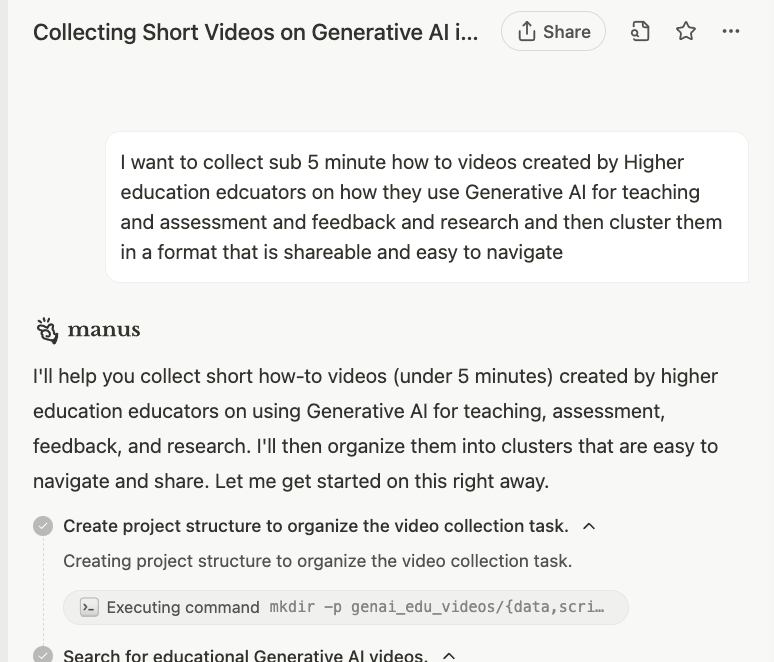
I wanted to see what I could get from a single prompt so decided to see if it could build a shareable, searchable web page that curates short how-to videos (under five minutes) by higher education educators demonstrating uses of Generative AI. I began by requesting Manus to collect and cluster videos showing how AI is applied in teaching, assessment, feedback, and research (Natural Language Prompt). Manus responded immediately by creating a structured project directory and initiating web searches to identify relevant video content, starting with collections from institutions like Notre Dame and Harvard (which it didn’t get beyond in the first iteration).

Once videos were sourced, Manus automatically filtered them to ensure they were under five minutes in length (but failed to note that one wasn’t a video and others linked to same page where they were already curated!) and produced by educators in the higher education sector (this it did get right). It then categorised them by thematic area (Teaching, Assessment & Feedback, AI Literacy, and Research but the categrosations were not always spot on) while also tagging institutional affiliations (mostly OK). The tagging and filtering work pretty well but the actual sourcing is very limited in that first iteration. A metadata database was created to support an interactive interface, allowing users to search videos by presenter, title, or description and filter by category or institution. Manus built this interface and deployed the collection to a live web page: https://cjubrvkx.manus.space. It took about 15 minutes. Iteration is by natural language prompting for fine tuning.

The initial prompt from me and the start of the executaiton of the processes

After launch, I expanded the scope by asking Manus to include contributions from additional individuals and institutions- I threw in my old buddy Dr. Gerhard Kristandl (Dr GeeKay) who I know has a YouTube channel, I added me- Martin Compton (without any additional info) and it found relevant content from each of us. The other three potential souces I threw in reaped no reward though. This is the reasoning:

I searched for content from Tadhg Blommerde, University of Sydney, and Monash University as well, but most of their videos exceeded our 5-minute duration criteria. I’ve documented all findings in the data directory for reference.

Manus resumed its asynchronous task execution, searching for and integrating further video content into the existing framework enabling me to publish a second version . So the output works, I would need much more thoughtful prompting to get it how I want it and, tbh, there are better ways of curating YouTube content but the principle is what interested me and the output is remarkable given the stages and processes it went through.

You can watch a replay of the agent in action here. Not as much fun as watching Napoleon Solo and Illya Kuryakin combat THRUSH (I know, I know).