Conversing with AI: Natural language exchanges with and among the bots

In the fast evolving landscape of AI tools, two recent releases have really caught my attention: Google’s NotebookLM and the advanced conversational features in ChatGPT. Both offer intriguing possibilities for how we might interact with AI in more natural, fluid ways.

NotebookLM, still in its experimental stage and free to use, is well worth exploring- as one of my King’s colleagues pointed out recently: it’s about time Google did something impressive in this space! Its standout feature is the ability to generate surprisingly natural-sounding ‘auto podcasts’. I’ve been particularly struck by how the AI voice avatars exchange and overlap in their speech patterns, mimicking the cadence of real conversation. This authenticity is both impressive and slightly unsettling and at least two colleagues thought they were listing to human exchanges.

I tested this feature with three distinct topics:

Language learning in the age of AI (based on three online articles):

A rather flattering exchange about my blog posts (created in fact by my former colleague Gerhard Kristandl – I’m not that egotistical):

A summary of King’s generative AI guidance:

The results were remarkably coherent and engaging. Beyond this, NotebookLM offers other useful features such as the ability to upload multiple file formats, synthesise high-level summaries, and generate questions to help interrogate the material. Perhaps most usefully, it visually represents the sources of information cited in response to your queries, making the retrieval-augmented generation process transparent.
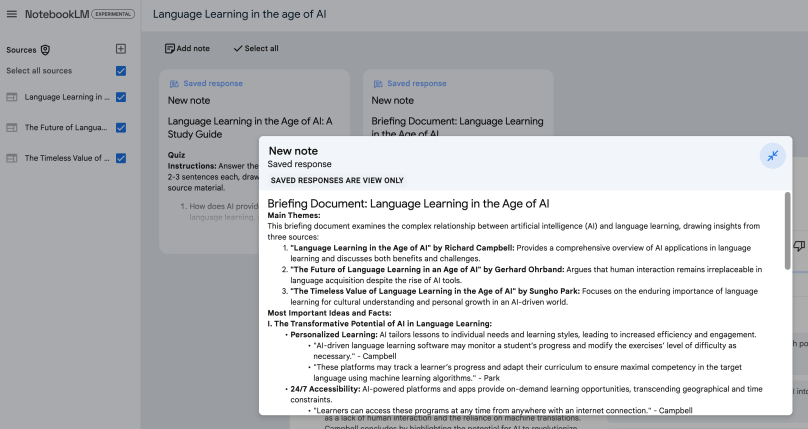
The image is a screenshot of a NotebookLM (experimental) interface with a note titled "Briefing Document: Language Learning in the Age of AI." It includes main themes and insights from three sources on the relationship between artificial intelligence (AI) and language learning:

1. **"Language Learning in the Age of AI" by Richard Campbell**: Discusses AI applications in language learning, highlighting both benefits and challenges.
2. **"The Future of Language Learning in an Age of AI" by Gerhard Ohrband**: Emphasizes that human interaction remains crucial despite AI tools in language acquisition.
3. **"The Timeless Value of Language Learning in the Age of AI" by Sungho Park**: Focuses on the cultural and personal value of language learning in an AI-driven world.

The note then expands on important ideas, specifically on the transformative potential of AI in language learning, such as personalized learning and 24/7 accessibility through AI-driven platforms.

Meanwhile, ChatGPT’s latest update advance voice feature (not available in EU, by the way) has addressed previous latency issues, resulting in a much more realistic exchange. To test this, I engaged in a brief conversation, asking it to switch accents mid-dialogue. The fluidity of the interaction was notable, feeling much closer to a natural conversation than previous iterations. Watch here:

What struck me during this exchange was how easily I slipped into treating the AI as a sentient being. At one point, I found myself saying “thank you”, while at another I felt a bit bad when I abruptly interrupted. This tendency to anthropomorphise these tools is deeply ingrained and hard to avoid, especially as the interactions become more natural. It raises interesting questions about how we relate to AI and whether this human-like interaction is beneficial or potentially problematic.

These developments challenge our conventions around writing and authorship. As these tools become more sophisticated, the line between human and AI-generated content blurs further. What constitutes a ‘valid’ tool for authorship in this new landscape? How do we navigate the ethical implications of using AI in this way?

What are your thoughts on these developments? How might you see yourself using tools like NotebookLM or the advanced ChatGPT in your work?

Sources used for the Langauge ‘podcast’:

  1. Language Learning in the Age of AI” by Richard Campbell
  2. The Future of Language Learning in an Age of AI” by Gerhard Ohrband
  3. The Timeless Value of Language Learning in the Age of AI” by Sungho Park

Custom GPTs

There are two main audiences for custom GPTs built within the ChatGPT Pro insfrastucture. The first is anyone with a pro account. There are other tools that allow me to build custom GPTs with minimal skills that are open to wider audiences so I think it’ll be interesting to see whether OpenAI continue to leverage this feature to encourage new subscription purchases or whether it will open up to further stifle competitor development. In education the ‘custom bots for others’ potential is huge but, for now, I am realising how potentially valuable they might be for the audience I did not initially consider – me.

One that is already proving useful is ‘My thesis helper’ which I constructed to pull information only from my thesis (given that even the really obvious papers never materialsed I am wondering whether this might catalyse that!) It’s an opportunity to use as source material much larger documents than the copy/ paste tokens allow or even the relatively generous (and free) 100k tokens and document upload Claude AI permits. In particular, it facilitates much swifter searching within the document as well as opportunities for synthesising and summarising specific sections. Another is ‘Innovating in the Academy’ (try it yourself if you have a pro account) which uses two great sources of case studies from across King’s, collated and edited by my immediate colleagues in King’s Academy. The bot enables a more refined search as well as an opportunity to synthesise thinking.

Designed to be more outward facing is ‘Captain’s Counsel’. This I made to align with a ‘Star Trek’ extended (and undoubtedly excruciating) metaphor I’ll be using in a presentation for the forthcoming GenAI in Education conference in Ulster. Here I have uploaded some reference material but also opened it to the web. I have tried to tap into my own Star Trek enthusiasm whilst focussing on broader questions about teaching. The web-openness means it will happily respond to questions about many things under the broad scope I have identified though I have also identified some taboos. Most useful and interesting is the way it follows my instruction to address the issue with reference to Captain Kirk’s own experiences. 

Both the creation and use of customised bots enables different ways of perceiving and accessing existing information and it is in these functions broadly that LLMs and image generators as well as within customised bots are likely to establish a utility niche I think, especially for folk yet to dip their toes or whose perceptions are dominated by LLMs as free essay mills.