CPD for critical AI literacy: do NOT click here.

In 2018, Timos Almpanis and I co-wrote an article exploring issues with Continuous Professional Development (CPD) in relation to Technology Enhanced Learning (TEL). The article, which we published while working together at Greenwich (in Compass: Journal of Learning and Teaching), highlighted a persistent challenge: despite substantial investment in TEL, enthusiasm for it and use among educators remained inconsistent at best. While students increasingly expect technology to enhance their learning, and there is/ was evidence to supports its potential to improve engagement and outcomes, the traditional transmissive CPD models supporting how teaching academics were introduced to TEL and supported in it could undermine its own purpose. Focusing on technology and systems as well as using poor (and non modelling) pedagogy often gave/ give a sense of compliance over pedagogic improvement.

Because we are both a bit contrary and subversive we commissioned an undergraduate student (Christina Chitoroaga) to illustrate our arguments with some cartoons which I am duplicating here (I think I am allowed to do that?):
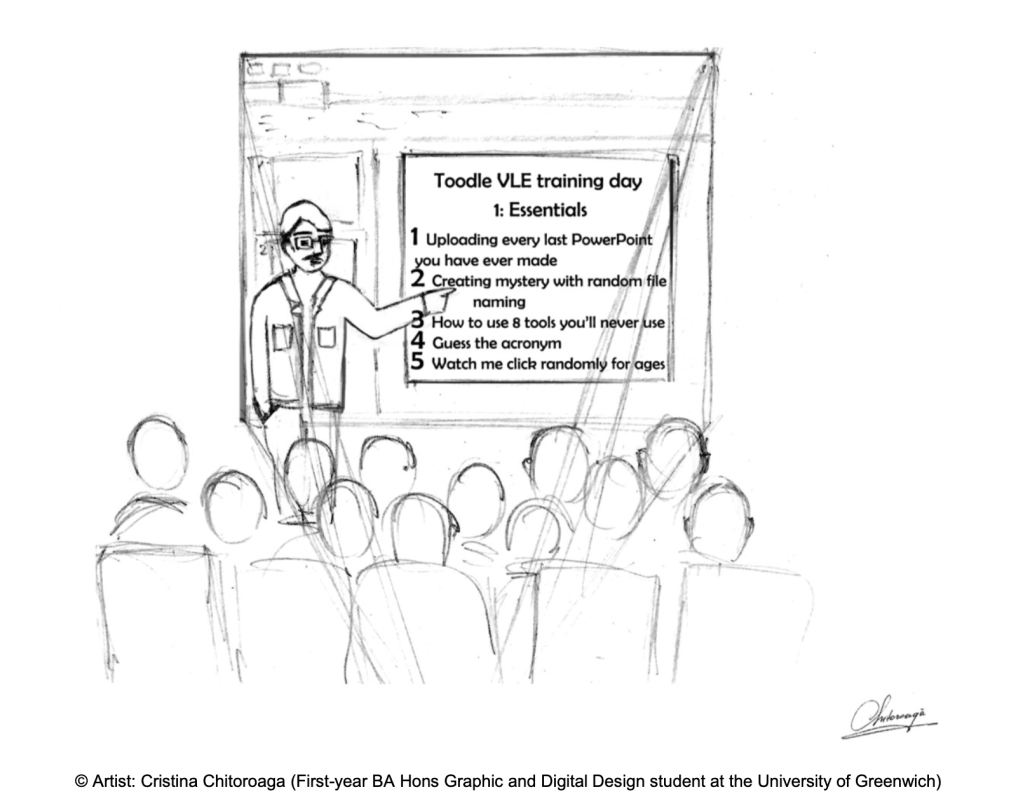
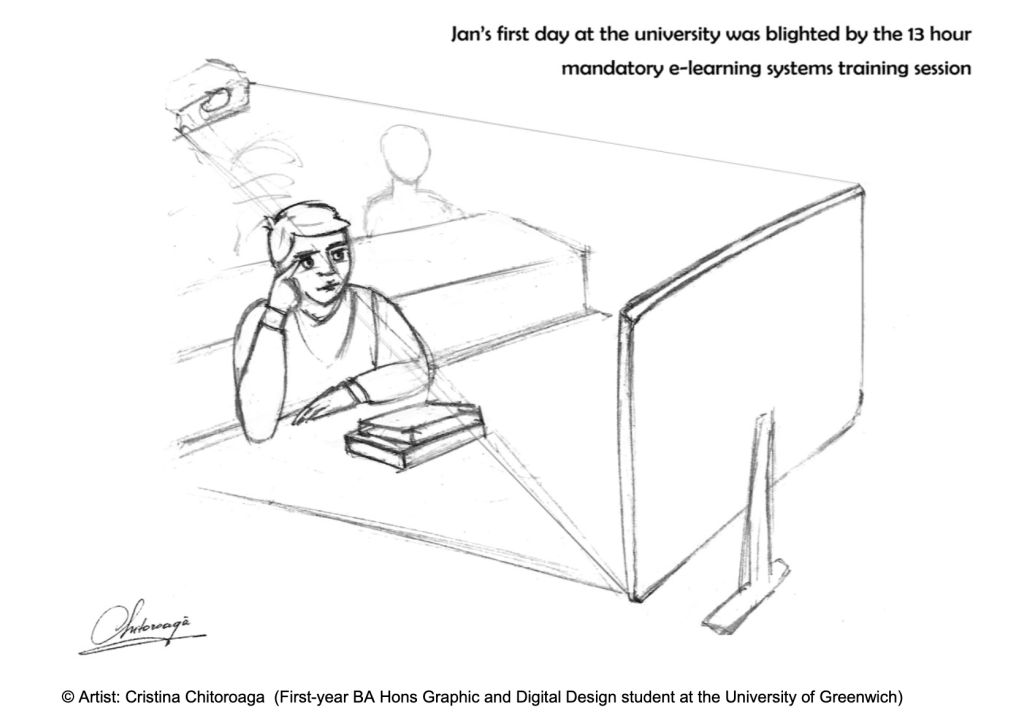
We argued that TEL focussed CPD should prioritise personalised and pedagogy-focused approaches over one-size-fits-all training sessions. Effective CPD that acknowledges need, relfects evidence-informed pedagogic apparoaches and empowers educators by offering choice, flexibility and relevance, will also enable them to explore and apply tools that suit their specific teaching contexts and pedagogical needs. By shifting the focus away from the technology itself and towards its purpose in enhancing learning, we can foster greater engagement and creativity among academic staff. This was exactly the approach I tried to apply when rolling out Mentimenter (a student response system to support increasing engagement in and out of class).

I was reminded of this article recently (because fo the ‘click here; clck there’ cartoon) when a colleague expressed frustration about a common issue they observed: lecturers teaching ‘regular’ students (I always struggle with this framing as most of my ‘students’ are my colleagues- we need a name for that! I will do a poll – got totally distracted by that but it’s done now) how to use software using a “follow me as I click here and there” method. Given that the “follow me as I click” is still a thing, perhaps it is time to adopt a more assertive and directive approach. Instead of simply providing opportunities to explore better practices, we may need to be clearer in saying: “Do not do this.” I mean I do not want to be the pedagogy police but while there is no absolute right way there are some wrong ways, right? Also we might want to think about what this means in terms of the AI elephant in every bloomin’ classroom.

The deluge of AI tools and emerging uses of these tech (willingly and unwillingly & appropriately and inappropriately) means the need for effective upskilling is even more urgent. However we support skill development and thinking time we need of course to realise it requires moving beyond the “click here, click there” model. In my view (and I am aware this is contested) educators and students need to experiment with AI tools in real-world contexts, gaining experience in how AI is impacting curricula, academic use and, potentially, pedagogic practices. The many valid and pressing reasons why teachers might resist or reject engaging with AI tools: workload, ethical implications, data privacy, copyright, eye-watering environmental impacts or even concern about being replaced by technology are a significant barriers to adoption. But adoption is not my goal; critical engagement is. The conflation of the two in the minds of my colleagues is I think a powerful impediment before I even get a chance to bore them to death with a ‘click here; click there’. In fact, there’s no getting away from the necessity of empathy and a supportive approach, one that acknowledges these fears while providing space for dialogue and both critical AND creative applications of responsibly used AI tools. In fact, Alison Gilmour and I wrote about this too! It’s like all my work actually coheres!

Whatever the approach, CPD cannot be a one-size-fits-all solution, nor can it rely on prescriptive ‘click here, click there’ methods. It must be compassionate and dialogic, enabling experimentation across a spectrum of enthusiasm—from evangelical to steadfast resistance. While I have prioritised ‘come and play’, ‘let’s discuss’, or ‘did you know you can…’ events, I recognise the need for more structured opportunities to clarify these underpinning values before events begin. If I can find a way to manage such a shift it will help align the CPD with meaningful, exploratory engagement that puts pedagogy and dialogue at the heart of our ongoing efforts to grow critical AI literacy in a productive, positive way that offers something to everyone wherever they sit of the parallel spectrums of AI skills and beliefs.

Post script: some time ago I wrote on the WONKHE blog about growing AI literacy and this coincided wiht the launch of the GEN AI in HE MOOC. We’re working on an expanded version- broadening the scope of AI beyond the utterly divisive ‘generative’ as well as widening the scope to other sectors of education. Release due in May. It’ll be free to access.

Navigating the Path of Innovation: Dr. Mandeep Gill Sagoo’s Journey in AI-Enhanced Education

Dr. Mandeep Gill Sagoo, a Senior Lecturer in Anatomy at King’s College London, is actively engaged in leveraging artificial intelligence (AI) to enhance education and research. Her work with AI is concentrated on three primary projects that integrate AI to address diverse challenges in the academic and clinical settings. The following summary (and title and image, with a few tweaks from me) was synthesised and generated in ChatGPT using the transcript of a fireside chat with Martin Compton from King’s Academy. The whole conversation can be listened to here.

AI generated image of a path winding through trees in sunlight and shadow
  1. Animated Videos on Cultural Competency and Microaggression: Dr. Sagoo has led a cross-faculty project aimed at creating animated, thought-provoking videos that address microaggressions in clinical and academic environments. This initiative, funded by the race equity and inclusive education fund, involved collaboration with students from various faculties. The videos, designed using AI for imagery and backdrops, serve as educational tools to raise awareness about unconscious bias and microaggression. They are intended for staff and student training at King’s College London and have been utilised in international collaborations. Outputs will be disseminated later in the year.
  2. AI-Powered Question Generator and Progress Tracker: Co-leading with a second-year medical student and working across faculties with a number of others, Dr. Sagoo received a college teaching fund award to develop this project, which is focused on creating an AI system that generates single best answer questions for preclinical students. The system allows students to upload their notes, and the AI generates questions, tracks their progress, and monitors the quality of the questions. This project aims to refine ChatGPT to tailor it for educational purposes, ensuring the questions are relevant and of high quality.
  3. Generating Marking Rubrics from Marking Schemes: Dr. Sagoo has explored the use of AI to transform marking schemes into detailed marking rubrics. This project emerged from a workshop and aims to simplify the creation of rubrics, which are essential for clear, consistent, and fair assessment. By inputting existing marking schemes into an AI system, she has been able to generate comprehensive rubrics that delineate the levels of performance expected from students. This project not only streamlines the assessment process but also enhances the clarity and effectiveness of feedback provided to students.

Dr. Sagoo’s work exemplifies a proactive approach to incorporating AI in education, demonstrating its potential to foster innovation, enhance learning, and streamline administrative processes. Her projects are characterised by a strong emphasis on collaboration, both with students and colleagues, reflecting a commitment to co-creation and the sharing of expertise in the pursuit of educational excellence.

Contact Mandeep

A pedagogy of care (hu)manifesto

Martin Compton & Rebecca Lindner

Teachers who care, who serve their students, are usually at odds with the environments wherein we teach (hooks, 2013)

It is very easy in a modern university to get absorbed with systems, processes, data and results that often de-centre the individuals that work and study within these systems. We hear increasingly of the troubling consequences of student wellbeing issues and of staff burnout, and the pandemic has exacerbated many of the tensions and issues consequent of highly-pressurised ways of working and being that are common in higher education. A pedagogy of care deliberately pushes against these pressurised phenomena. It centres individuals by starting with respect, trust, inclusion and relationship-building as precursors to dialogue and affective development as well as academic development.

even for the majority who do “care” in the virtue sense—that is, they profess to care and work hard at their teaching—there are many who do not adopt the relational sense of caring. (Noddings, 2005)

As a prompt for discussion and as a starting point to help us all (as educators working in HE) interrogate our own current practices, we offer the following ‘pedagogy of care (hu)manifesto’ which draws on core concepts, principles and ideas found in the works cited below. We invite colleagues to consider their own (and their peers’) practices in light of each of these statements, to identify tensions, challenges, objections and potential pitfalls as well as opportunities, examples and affordances suggested by each of the commitments.

By embracing a pedagogy of care, we endeavour to:

1.      Humanise things! Understand the value of connecting at a human level and modelling caring 
2.      Challenge conventions of hierarchy and authority 
3.      Challenge the narratives and norms of rigour and educational ‘suffering’ 
4.      Normalise learning through mistakes 
5.      Recognise that positive relationships demand trust: Being ‘nice’ does not mean being indirect or dishonest 
6.      Appreciate that dialogue is essential to showing care (and listening is at least half of this!) 
7.      Accept that humility and normalising vulnerability show strength not weakness 
8.      Show and tell students that you care- DO smile before winter break! 
9.      Employ flexibility, openness and welcome with office hours 
10.   Above all: acknowledge where each student is at and don’t enforce behaviours or punish recalcitrance 

In the case of wellbeing interventions in higher education, lesson- learning, sharing good practice and building networks around ideas and interventions are all important, but it is also critical to understand factors that shape HE organisations’ abilities to successfully take this knowledge forward and address wellbeing problems. (Watson & Turnpenny, 2022)

Sources

Blake, S., Capper, G. & Jackson, A. Building Belonging in HE https://wonkhe.com/wp-content/wonkhe-uploads/2022/10/Building-Belonging-October-2022.pdf

Denial, C. (2019) A Pedagogy of Kindnesshttps://hybridpedagogy.org/pedagogy-of-kindness/

hooks, b. (1994) Teaching to transgress. Oxon: Routledge

hooks, b. (2013) Teaching community: A pedagogy of hope. Routledge.

Hughes, G, Upsher, R, Nobili, A, Kirkman, A, Wilson, C, Bowers- Brown, T, Foster, J, Bradley, S and Byrom, N (2022) Education for Mental Health. Advance HE.

Larsen, A. (2015) ‘Who cares?’ Developing a pedagogy of care in higher education (Phd Thesis). Utah State University Library

Noddings, N. (2005) Caring in education’ The encyclopedia of informal Education.

Pilato, N. (2018) Pedagogy of care: Embodied relationships of teaching and mentorship. IJEA Vol. 19: 1.9

Watson, D.  & Turnpenny, J. (2022) Interventions, practices and institutional arrangements for supporting PGR mental health and wellbeing: reviewing effectiveness and addressing barriersStudies in HE.