In the fast evolving landscape of AI tools, two recent releases have really caught my attention: Google’s NotebookLM and the advanced conversational features in ChatGPT. Both offer intriguing possibilities for how we might interact with AI in more natural, fluid ways.
NotebookLM, still in its experimental stage and free to use, is well worth exploring- as one of my King’s colleagues pointed out recently: it’s about time Google did something impressive in this space! Its standout feature is the ability to generate surprisingly natural-sounding ‘auto podcasts’. I’ve been particularly struck by how the AI voice avatars exchange and overlap in their speech patterns, mimicking the cadence of real conversation. This authenticity is both impressive and slightly unsettling and at least two colleagues thought they were listing to human exchanges.
I tested this feature with three distinct topics:
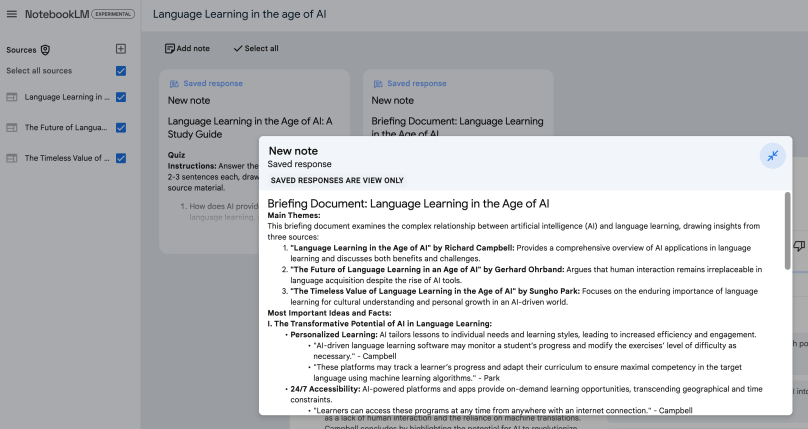
Language learning in the age of AI (based on three online articles):
A rather flattering exchange about my blog posts (created in fact by my former colleague Gerhard Kristandl – I’m not that egotistical):
A summary of King’s generative AI guidance:
The results were remarkably coherent and engaging. Beyond this, NotebookLM offers other useful features such as the ability to upload multiple file formats, synthesise high-level summaries, and generate questions to help interrogate the material. Perhaps most usefully, it visually represents the sources of information cited in response to your queries, making the retrieval-augmented generation process transparent.
Meanwhile, ChatGPT’s latest update advance voice feature (not available in EU, by the way) has addressed previous latency issues, resulting in a much more realistic exchange. To test this, I engaged in a brief conversation, asking it to switch accents mid-dialogue. The fluidity of the interaction was notable, feeling much closer to a natural conversation than previous iterations. Watch here:
What struck me during this exchange was how easily I slipped into treating the AI as a sentient being. At one point, I found myself saying “thank you”, while at another I felt a bit bad when I abruptly interrupted. This tendency to anthropomorphise these tools is deeply ingrained and hard to avoid, especially as the interactions become more natural. It raises interesting questions about how we relate to AI and whether this human-like interaction is beneficial or potentially problematic.
These developments challenge our conventions around writing and authorship. As these tools become more sophisticated, the line between human and AI-generated content blurs further. What constitutes a ‘valid’ tool for authorship in this new landscape? How do we navigate the ethical implications of using AI in this way?
What are your thoughts on these developments? How might you see yourself using tools like NotebookLM or the advanced ChatGPT in your work?
Sources used for the Langauge ‘podcast’:
- “Language Learning in the Age of AI” by Richard Campbell
- “The Future of Language Learning in an Age of AI” by Gerhard Ohrband
- “The Timeless Value of Language Learning in the Age of AI” by Sungho Park
 HEducationist