TL:DR? No, it is not, so why would you embrace it?
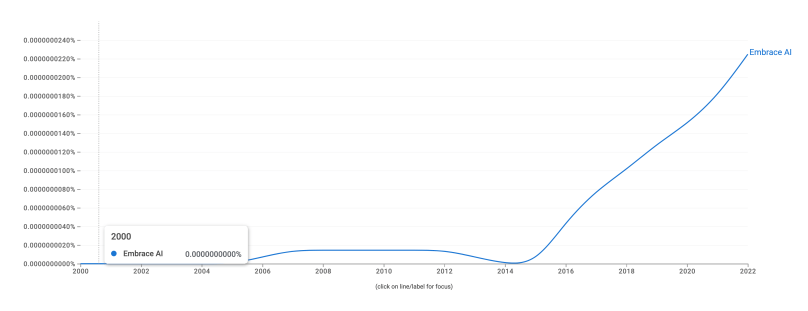
I have mentioned this before but it keeps cropping up so I am going to labour the point again. The idea of ‘embracing’ AI in education (or anywhere) can be seen to grow as a narrative throughout 2023 and was already on a steep upward trajectory prior to that.
But a significant contribution to this notion came in this HEPI blog of 5 January 2024. Professor Yike Guo urges UK universities to move beyond mere caution and become active adopters of artificial intelligence. Drawing on 34 years of AI, data-mining and machine-learning research at Imperial College London and his role as Provost at HKUST, he warned that AI is not a peripheral tool but a fundamental shift in the educational paradigm. His focus on structural, systemic and pre-existing issues in how we construct education such as the persistence of rote memorisation in curricula mirrors my own case for using AI as an opportunity to leverage research-informed changes long needed. Professor Guo advocates for compulsory AI literacy modules that teach students to interrogate and collaborate with digital co-pilots and insists that the true value of education will lie in cultivating ethical reasoning, emotional intelligence and creativity which, importantly, are qualities that machines cannot replicate. He says (and I quote this a lot):
“…UK universities face a choice: either embrace AI as an integral component of academic pursuit or risk obsolescence in a world where digital co-pilots could become as ubiquitous as textbooks.”
I tend to agree with much of Professor Guo’s stance: AI will reshape (and already is) higher education pretty profoundly but I find his call to “embrace” AI really troubling. This phrase seems to be everywhere in relation to AI. I hear it every day and I don’t think it is helpful at all. I embrace my wife and daughter (and, somewhat awkwardly, my son and my mum: it’s a generational thing I think!), a kitten, and even my Spurs-supporting mates last week when we finally won a trophy after 17 years of pain (see picture below).

But I do not embrace people or things I neither know nor trust. I do not embrace strangers. Even when I employed someone to complete a loft conversion, and we came to know them well over the course of the (interminable) job, we still didn’t end up hugging each other. Some people love their phones too much and might kiss and hug them but I think they’re daft. These are tools, nothing more. ‘Embracing AI’ narratives only feed anthropomorphism. It also feeds binary narratives: are you ‘fully embrace’ or ‘outright reject’? Actually, reality demands something far more nuanced.
To these ends, I am constantly challenging the idea of embracing AI. So, instead, I argue for engagement. We can engage with affection, care, warmth and appreciation, but we can also engage with suspicion, trepidation, anxiety, distrust, even fear. Engagement accommodates critical scrutiny as readily as it does positive and productive collaboration.So, bottom line, let’s drop the idea of embracing AI but encourage critical engagement with AI (in all its diversity…what we conceptualise AI as is another thing that vexes me btw). Also: Come on you Spurs!
 HEducationist
Good post Martin. I seem to have too many conversations with people fully embracing or totally rejecting AI in education – either end of this spectrum doesn’t really help with the complexities of AI! Good to see Spurs engaging with some silver ware though!
LikeLiked by 1 person
[…] (for example) that more widely defined AI promises. As I keep saying this doesn’t mean we need to rush to embrace anything nor does it imply that educators must become computer scientists overnight. But it does mean […]
LikeLike
Hi Martin. Thank you for the post. I think we all are still in the process of figuring things out when it comes to AI in education, and because things are happening so rapidly, it doesn’t get any easier. I am sure though that we will find the middle ground and overcome (to an extent, of course) the challenging complexities of AI.
LikeLike