Modifying or changing assessment ‘because of AI’ always feels like it feeds ‘us and them’ narratives of a forthcoming apocalypse (already predicted) and couches the change as necessary only because of this insidious, awful thing that no-one wants except men in leather chairs who stroke white cats.
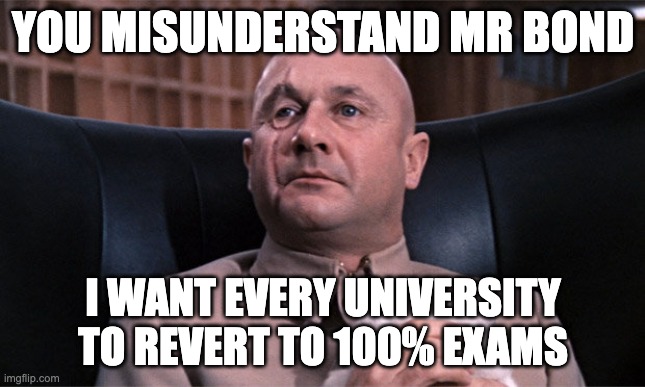
It is of course MUCH more complex than that and much of the desired change has been promoted by folk with a progressive, reform, equity, inclusion eye who do (or immerse themselves in) scholarship of HE pedagogy and assessment practices.
Anyway, a colleague suggested that we should have a collection of ideas about practical ways assessments could be modified to either make them more AI ‘robust’ or at least ‘AI aware’ or ‘ AI inclusive’ (I’m hesitant to say ‘resitant’ of course). Whilst colleagues across King’s have been sharing and experimenting it is probably true to say that there is not a single point of reference. We are in King’s Academy working on remedying this as part of the wider push to support TASK (transforming assessment for students at King’s) and growing AI literacy but first I wanted to curate a few examples from elsewhere to offer a point of reference for me and to share with colleagues in the very near future. I’ve gone for diversity from things I have previously book marked. Other than that, they are here only to offer points of discussion, inspiration, provocation or comparison!
Before I start I should remind KIng’s colleagues of our own guidance and the assessment principles therein, note that with collleagues at LSE, UCL and Southampton I am working on some guidance on the use of AI to assist with marking (forthcoming and controversial). Some of the College Teaching Fund projects looked at assessment and This AI Assessment Scale from Perkins et al. (2024) has a lot of traction in the sector too and is not so dissimilar from the King’s 4 levels of use approach. It’s amazing how 2023 can feel a bit dated in terms of resources these days but this document form the QAA is still relevant and applicable and sets out broader, sector level approarpriate principles. In summary:
- Institutions should review and reimagine assessment strategies, reducing assessment volume to create space for activities like developing AI literacy, a critical future graduate attribute.
- Promote authentic and synoptic assessments, enabling students to apply integrated knowledge practically, often in workplace-related settings, potentially incorporating generative AI.
- Move away from traditional, handwritten, invigilated exams towards innovative approaches like digital exams, observed discipline-specific assessments or oral examinations
- Design coursework explicitly integrating generative AI, encouraging ethical use, reflection, and hybrid submissions clearly acknowledging AI-generated content.
- Follow guiding principles ensuring assessments are sustainable, inclusive, aligned to learning outcomes, and effectively demonstrate relevant competencies, including appropriate AI usage.
I’m also increasingly referring to the two lane approach being adopted by Sydney which leans heavily into similar principles. Context is different to UK of course but I have a feeling we will find ourselves moving much closer to the broad approach here. It feels radical but perhaps no more radical than what many, if not most, unis did in Covid.

Finally, the examples
Example 1. UCL Medical Sciences BSc.
- Evaluation of coursework assessments to determine susceptibility to generative AI and potential integration of AI tools.
- Redesign of assessments to explicitly incorporate evaluation of ChatGPT-generated outputs, enhancing critical evaluation skills and understanding of AI limitations.
- Integration of generative AI within module curricula and teaching practices, providing formative feedback opportunities.
- Collection of student perspectives and experiences through questionnaires and focus groups on AI usage in learning and assessments.
- Shift towards rethinking traditional assessment formats (MCQs, SAQs, essays) due to AI’s impact, encouraging ongoing pedagogical innovation discussions.
Example 2 – Cardiff University Immunology Wars
- Gamification: Complex immunology concepts taught through a Star Wars-inspired, game-based approach.
- AI-driven game design: ChatGPT 4.0 used to structure game scenarios, resources, and dynamic challenges.
- Visual resources with AI: DALLE-3 employed to create engaging imagery for learning materials.
- Iterative AI prompting: An innovative method using progressive ChatGPT interactions to refine complex game elements.
- Practical, collaborative learning: Students collaboratively trade resources to combat diseases, supported by iterative testing and refinement of the game.
Example 3 Traffic lights University Winsconsin Green Bay
The traffic light system they are implementing is reflected in these three sample assessments:
- Red light – prohibited
- Yellow light – limited use
- Green Light – AI embedded into the task

Example 4 Imperial Business School MBA group work
- Integration of AI: The original essay task was redesigned to explicitly require students to use an LLM, typically ChatGPT.
- The change: Individual component of wider collaborative task. Students submit both the AI-generated output (250 words) and a critical evaluation of that output (250 words) on what is unique about a business proposal.
- Critical Engagement Emphasis: The new task explicitly focuses on students’ critical analysis of AI capabilities and limitations concerning their business idea.
- Reflective Skill Development: Students prompted to reflect on, critique, and consider improvements or extensions of AI-generated content, enhancing their evaluative and adaptive skills.
3 for 1! Example 5 – Harvard
Create a fictional character and interview them
World building for creative writing
More to follow…
Also note:
Manifesto for the essay
Related article (Compton & Gordon, 2024)
Also see: (Syska, 2025)We tried to kill the essay
 HEducationist
[…] But how? And why even? Practical examples of ways assessments have been modified a collection of ideas about practical ways assessments could be modified to either make them more AI ‘robust’ or at least ‘AI aware’ or ‘AI inclusive’ […]
LikeLike